
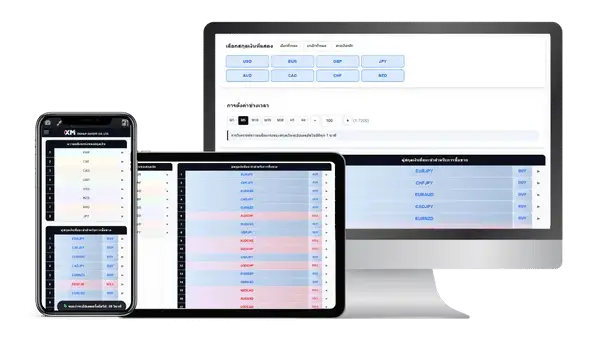
How to use this tool — see the full guide at the bottom of this page.
| Currency Strength Ranking | ||
|---|---|---|
| 1 | 1 | 1 |
| 2 | 2 | 2 |
| 3 | 3 | 3 |
| 4 | 4 | 4 |
| 5 | 5 | 5 |
| 6 | 6 | 6 |
| 7 | 7 | 7 |
| 8 | 8 | 8 |
| Recommended Trading Pairs | |||
|---|---|---|---|
| 1 | 1 | 1 | 1 |
| 2 | 2 | 2 | 2 |
| 3 | 3 | 3 | 3 |
| 4 | 4 | 4 | 4 |
| 5 | 5 | 5 | 5 |
| 6 | 6 | 6 | 6 |
| 7 | 7 | 7 | 7 |
| 8 | 8 | 8 | 8 |
| 9 | 9 | 9 | 9 |
| 10 | 10 | 10 | 10 |
| 11 | 11 | 11 | 11 |
| 12 | 12 | 12 | 12 |
| 13 | 13 | 13 | 13 |
| 14 | 14 | 14 | 14 |
| 15 | 15 | 15 | 15 |
| 16 | 16 | 16 | 16 |
| 17 | 17 | 17 | 17 |
| 18 | 18 | 18 | 18 |
| 19 | 19 | 19 | 19 |
| 20 | 20 | 20 | 20 |
| 21 | 21 | 21 | 21 |
| 22 | 22 | 22 | 22 |
| 23 | 23 | 23 | 23 |
| 24 | 24 | 24 | 24 |
| 25 | 25 | 25 | 25 |
| 26 | 26 | 26 | 26 |
| 27 | 27 | 27 | 27 |
| 28 | 28 | 28 | 28 |
Contents
What Is Currency Strength? — A Beginner’s Guide to Using the Analysis Tool
Most Forex traders rely on individual currency pair charts when making trading decisions. However, looking at the USDJPY chart alone makes it difficult to determine whether USD is strengthening or JPY is weakening.
Currency strength analysis is a technique that comprehensively evaluates the relationships between eight major currencies (USD, EUR, GBP, JPY, AUD, CAD, CHF, NZD) and converts their relative strength into numerical rankings. This allows traders to objectively identify which currencies are currently being bought the most — and which are being sold.
Traditionally, this required opening multiple currency pair charts simultaneously for comparison. With a currency strength tool, that complex process is automated, giving you an instant overview of the broader market flow.
How to Read the Currency Strength Ranking Table
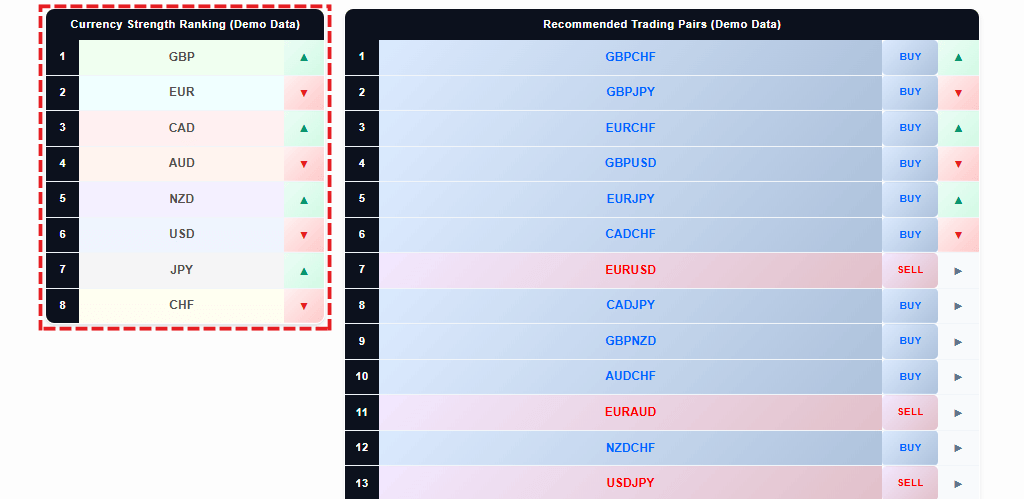
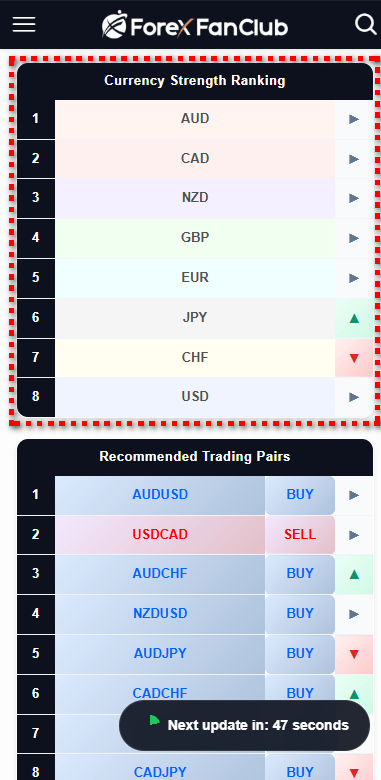
The currency ranking table (highlighted in red in the reference image) displays the current strength of each currency from 1st to 8th place. Rank 1 is the strongest currency, and rank 8 is the weakest. The arrows beside each currency indicate changes compared to the previous update: an upward arrow (▲) means the rank has risen, a downward arrow (▼) means it has fallen, and a right-pointing arrow (►) means the rank is unchanged.
How to Make the Most of the Recommended Trading Pairs
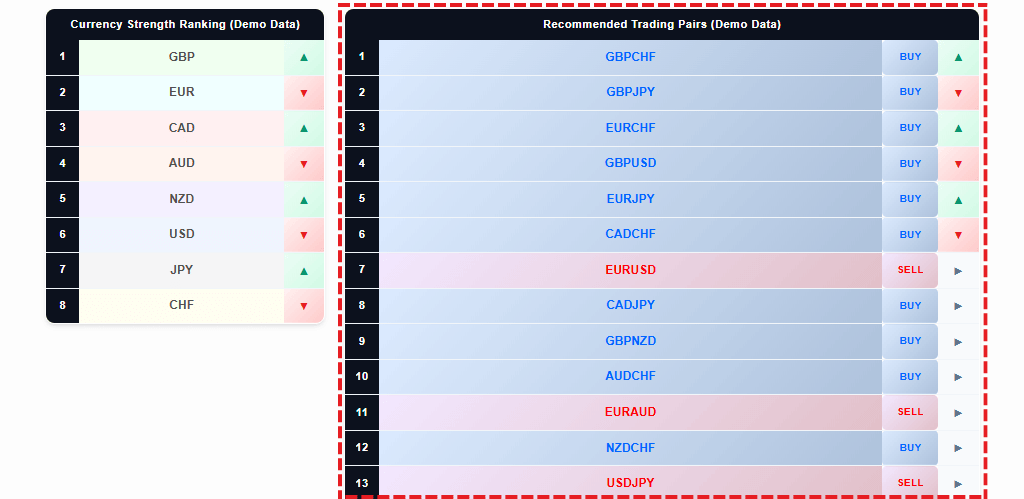
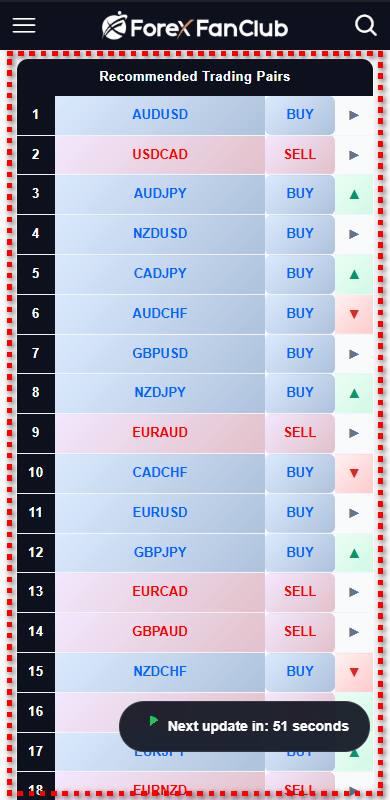
The recommended trading pairs table (highlighted in red in the reference image) ranks the currency pairs with the highest trading value based on the current currency strength analysis results. Each pair displays either BUY (recommended to buy) or SELL (recommended to sell), derived from the combination of a strong currency and a weak currency.
Pairs with a higher recommendation score indicate a clear strong-weak relationship, suggesting a higher probability of trend continuation. That said, a high recommendation score does not guarantee a winning trade. This tool is designed to help you quickly assess market conditions and serves as a decision-support aid for your trading.
Understanding and Choosing Your Timeframe Setting
The timeframe setting (highlighted in red in the reference image) adjusts the analytical window used for calculation. There are seven levels available, ranging from “M1 (1 minute)” to “H4 (4 hours)”, each reflecting price movements across different timeframes. Shorter settings such as M1 or M5 are typically favoured by scalpers and day traders, capturing finer price fluctuations with precision. Longer settings such as H1 or H4 are suited to swing traders and position traders, providing a clearer view of the broader trend.
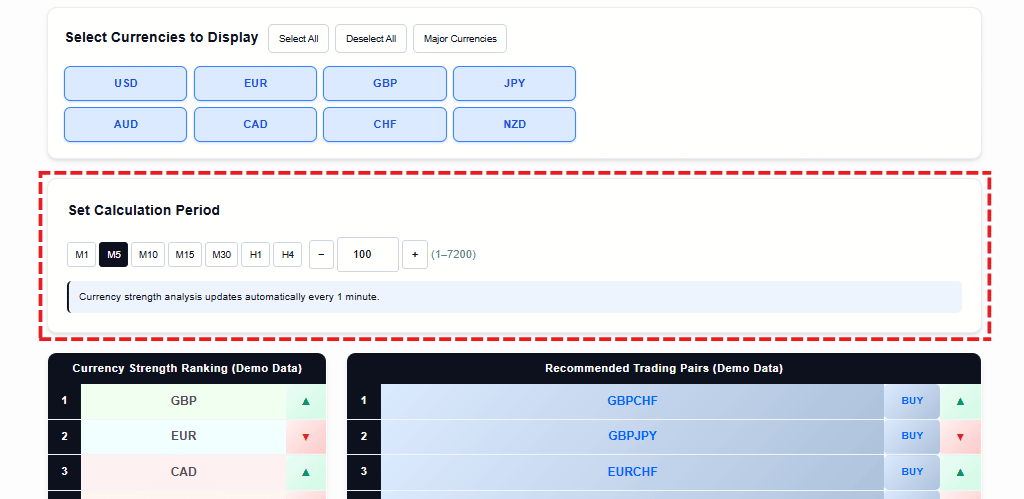
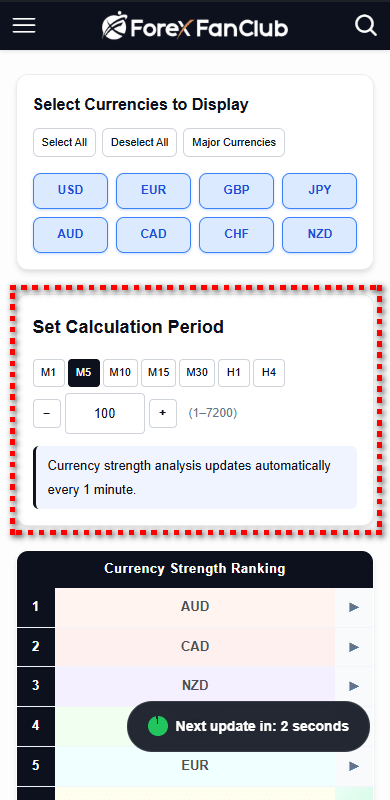
Personally, I start by reading currency strength from the higher timeframes and then narrow down to the M5 (5-minute) chart to select my trading pair. When following a trend, I buy the strongest currency and sell the weakest — maximising potential gains while minimising risk. After major economic data releases, I also use this tool to instantly gauge relative currency strength and identify the most relevant pairs to trade.
Currency Filter Function
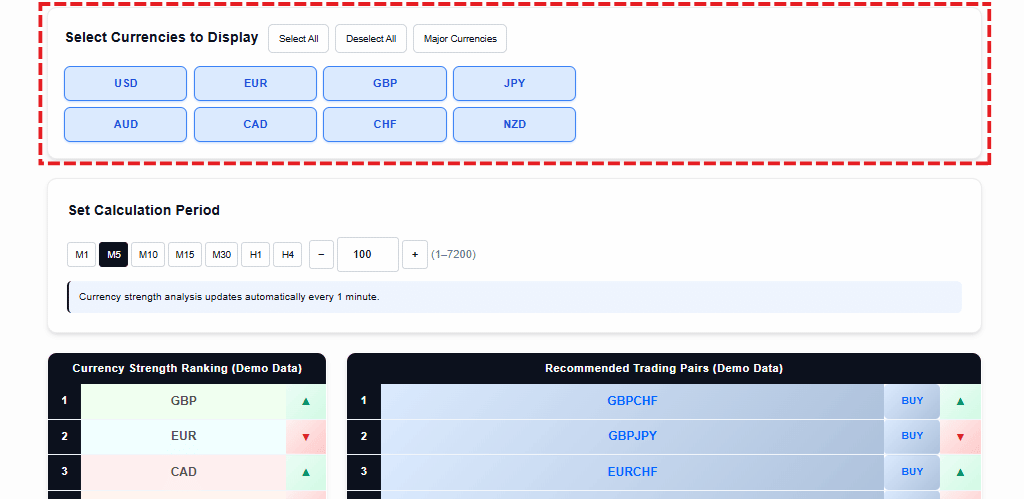
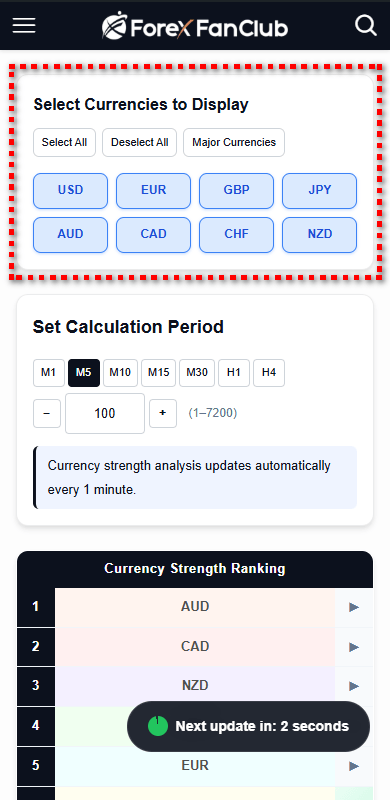
The currency filter function allows you to focus your analysis on specific currencies. It is designed for traders who want faster, more precise decisions — for example, by limiting the view to major currencies with tight spreads and high liquidity, excluding currencies that are relatively inactive during certain sessions, or removing highly correlated pairs that are less likely to develop clear trends. For beginners or those new to the tool, we recommend starting with a smaller selection and gradually expanding your watchlist as you gain experience.
Important Considerations When Using This Tool
While the currency strength tool is a powerful resource, very few traders rely on it exclusively. Most use it as a directional guide, with the final trading decision made through their own judgement or in combination with other analytical techniques.
In particular, during major economic data releases or unexpected news events, currency strength can shift rapidly. During such periods, it is advisable to prioritise fundamental factors over the tool’s readings.
Additionally, by its nature, this tool performs best during periods of clear trend formation. In ranging markets, currency strength rankings can alternate frequently, making it more difficult to act on signals. Please bear in mind that the tool’s effectiveness will vary depending on overall market conditions.
How the Currency Strength Tool Works — Mechanics & Custom Settings
This section explains how the tool works under the hood and how to fine-tune it by entering custom values. For most traders, the preset buttons are more than sufficient for everyday use. However, if you want to tailor the tool to your own trading style — or simply understand how the calculations work — read on.
Core Mechanics
This tool analyses currency strength by comparing the relative Simple Moving Average (SMA) values of each currency pair.
An SMA is a line calculated from the average closing prices over a specified period. For example, a 20 SMA represents the average closing price of the most recent 20 candles.
The concept of relative comparison can be understood simply as follows:
- USD vs EUR: USD stronger
- USD vs GBP: USD weaker
- USD vs JPY: USD stronger
- USD vs AUD: USD stronger
- USD vs CAD: USD stronger
- USD vs CHF: CHF stronger
Result: USD wins 6, loses 1 — therefore, USD ranks 2nd in relative strength.
This tool can therefore determine the relative strength or weakness between currencies, but it cannot measure the absolute level of strength or the momentum driving those movements.
How to Use the Preset Buttons
The preset buttons on the tool — such as “M1”, “M5”, and “H1” — have commonly used settings pre-configured for convenience.
- M1 = 20 SMA on 1-minute chart → numerical value “20”
- M5 = 20 SMA on 5-minute chart → numerical value “100”
- M15 = 20 SMA on 15-minute chart → numerical value “300”
- H1 = 20 SMA on 1-hour chart → numerical value “1200”
Since the tool fetches closing price data from the 1-minute chart and calculates the SMA from there, these figures are derived accordingly. Specific calculation examples are shown below.
- 20 SMA on 1-minute chart = calculated from 20 closing prices on the 1-minute chart
- 20 SMA on 5-minute chart = calculated from 100 closing prices on the 1-minute chart
- 20 SMA on 15-minute chart = calculated from 300 closing prices on the 1-minute chart
- 20 SMA on 1-hour chart = calculated from 1,200 closing prices on the 1-minute chart
In addition to the preset buttons, this currency strength tool also allows you to enter custom values manually.
How to Configure Custom Settings
To use a setting value other than the presets, simply enter a number directly in the field shown below.
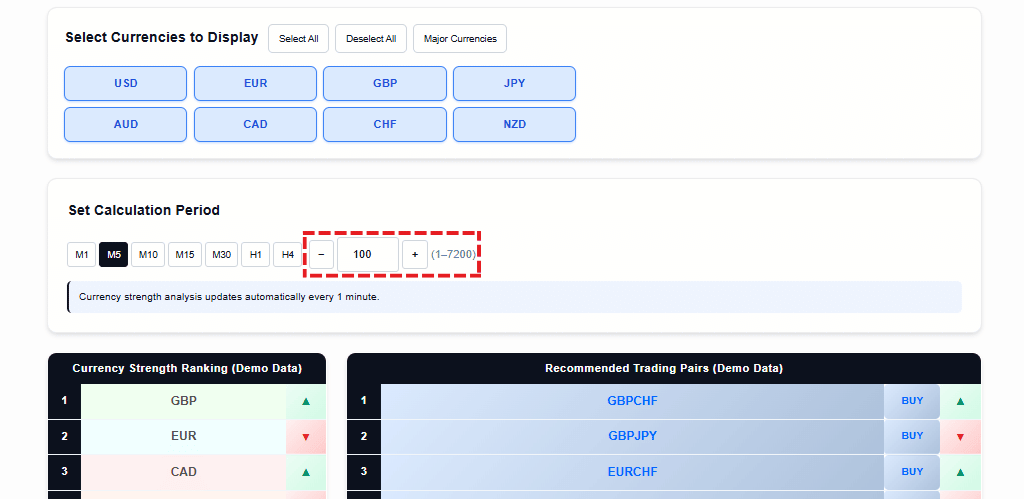
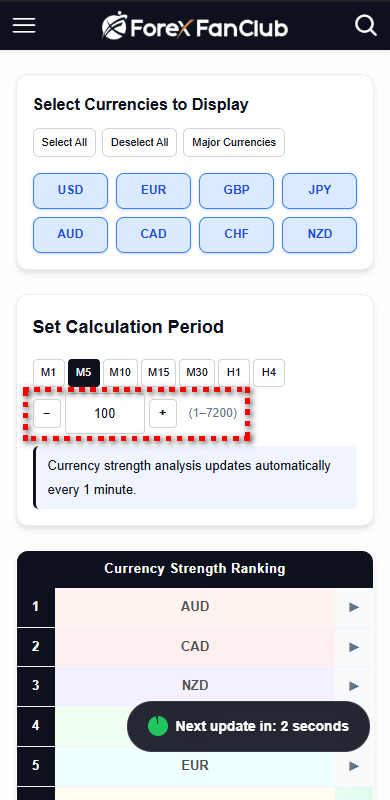
Below is the calculation formula and specific examples for using a 21 SMA in your currency strength analysis.
- 21 SMA on 1-minute chart → enter “21”
- 21 SMA on 5-minute chart → enter “105” (5 × 21 = 105)
- 21 SMA on 1-hour chart → enter “1260” (60 × 21 = 1260)
Please note that to preserve server-side computational resources, the maximum allowable setting value is “7200”, which is equivalent to a 30 SMA on the 4-hour chart.
Frequently Asked Questions About the Currency Strength Analysis Tool
Below we answer common questions from traders who are considering using — or are already using — the currency strength analysis tool. From basic usage and best practices to how the tool works and its limitations, we’ve compiled everything you need to get the most out of it in real trading scenarios.
- What is the currency strength analysis tool?
-
The currency strength analysis tool is a Forex analysis tool that converts the relative strength of eight major currencies (USD, EUR, GBP, JPY, AUD, CAD, CHF, NZD) into numerical scores and displays them as a real-time ranking table.
- Is the currency strength tool free to use?
-
Yes, the currency strength analysis tool is completely free to use. No registration or payment is required — simply open it in your browser and you’re ready to go. It is fully compatible with both PC and smartphone, so you can analyse currency strength anytime, anywhere.
- How often does the currency strength analysis update?
-
The currency strength analysis updates automatically every 1 minute. You can view the time remaining until the next update via the countdown timer in the bottom-right corner of the screen. Since the tool tracks market shifts in near real-time, it is invaluable for making timely trading decisions.
- Can Forex beginners use the currency strength tool?
-
Absolutely. Forex beginners can use it with ease — no complex setup is required. Simply refer to the currency ranking table and the recommended pairs displayed on screen. For beginners, we recommend starting with the “M15 (15-minute chart)” setting, as it produces fewer false signals and makes trend identification more straightforward.
- How should I choose the timeframe setting for the currency strength tool?
-
Choose your timeframe setting based on your trading style. For scalping, “M1” or “M5” is recommended. For day trading, try “M15” or “M30”. For swing trading, “H1” or “H4” is the better choice. Shorter settings capture finer price movements, while longer settings provide a clearer view of the macro trend.
- Do the top-ranked recommended pairs always win?
-
No. Even the highest-ranked recommended pairs do not guarantee a winning trade. The currency strength tool is designed to indicate market direction — not to guarantee win rates. We strongly recommend using a comprehensive trading strategy that incorporates entry timing, stop-loss placement, and sound capital management.
- Can the currency strength tool be used on a smartphone?
-
Yes, it is fully compatible with smartphones. The tool uses a responsive design that adapts seamlessly to both iPhone and Android devices, so you can check currency strength on the go — ideal for monitoring markets while away from your desk.
- How is currency strength calculated?
-
Currency strength is calculated by comparing the Simple Moving Averages of each currency pair on a relative basis. For example, USD strength is determined by comparing its performance across all pairs — against EUR, GBP, JPY, and so on — and then ranking it according to its total wins and losses.
- Which currencies should I select?
-
For beginners, we recommend clicking the “Major Currencies” button to limit the selection to USD, EUR, GBP, and JPY. These four currencies offer high liquidity and tight spreads, making them easier to trade. Once you’re comfortable, you can gradually add more currencies to uncover additional trading opportunities.
- Are there times when the currency strength tool is unavailable?
-
If an API connection error occurs, an error banner will appear at the top of the screen and test data will be displayed instead. You can attempt to reconnect by clicking the “Retry Connection” button. Outside of scheduled server maintenance, the tool is available 24 hours a day as standard.
The currency strength analysis tool excels at providing an instant overview of the relative strength and weakness across eight currencies, helping traders efficiently identify the most viable trading pairs. It is widely used by Forex traders as a key input for assessing market conditions before placing trades.
Traders who use it most effectively tend to select settings that match their own trading style, combine it with other analytical methods, and maintain sound risk management practices — rather than relying on the tool alone. Their decisions are based on a holistic assessment, not a single indicator.
Forex trading carries inherent risk, and no trade is guaranteed to be profitable. While this tool serves as a valuable reference point, we encourage you to continually learn, gain experience, and refine your decision-making over time. We wish you every success in your trading journey.
JOIN THE SYNDICATE
Optimize your edge. Leave nothing on the table.
Read the market’s currents with our intelligence, and minimize your trading costs with our infrastructure. Everything FFC provides exists for a single purpose: to give your positions a structural advantage that compounds with every lot traded. When you’re ready to stop playing on hard mode, open your rebate account and join us in maximizing every basis point this market has to offer.

This operational infrastructure is managed exclusively by CHIHEWANLE Ltd. All collected data is strictly secured and governed by our internal compliance protocols. This platform is operated solely under the domain https://www.fxfan.club/
Operated by: CHIHEWANLE Ltd.
Registration No.: 24917404
Address: No.50 12F-3, Chenggong Rd, North District, Tainan City, Taiwan
- What Is Currency Strength? — A Beginner’s Guide to Using the Analysis Tool
- How to Read the Currency Strength Ranking Table
- How to Make the Most of the Recommended Trading Pairs
- Understanding and Choosing Your Timeframe Setting
- Currency Filter Function
- Important Considerations When Using This Tool
- How the Currency Strength Tool Works — Mechanics & Custom Settings
- Core Mechanics
- How to Use the Preset Buttons
- How to Configure Custom Settings
- Frequently Asked Questions About the Currency Strength Analysis Tool
- JOIN THE SYNDICATE