

Trading Conditions
A Complete Guide to Account Types, Spreads, Swap Rates, Margin, and More
XM is an internationally recognised Forex broker offering highly competitive trading conditions. This guide provides a comprehensive breakdown of XM’s trading conditions — helping traders of all levels, from beginners to professionals, build more effective trading strategies.
We’ll analyse key trading conditions in detail — including spreads, swap rates, leverage, and required margin — all of which directly impact your profitability. Each feature is explained clearly so you can identify the conditions that best match your trading style.
Contents
- XM Trading Conditions Trading Conditions by Account Type
- XM Trading Conditions Spread Costs & Trading Conditions at XM
- XM Trading Conditions Swap Rate Trading Conditions at XM
- XM Trading Conditions Margin & Leverage Trading Conditions at XM
- XM Trading Conditions Trade Size & Lot Conditions at XM
- XM Trading Conditions Frequently Asked Questions About XM Trading Conditions
XM Trading Conditions Trading Conditions by Account Type
XM offers 5 distinct account types, each with its own unique features. Standard accounts are eligible for all promotions. Ultra Low accounts stand out with tight spreads and swap-free trading. The Shares account allows direct investment in US, UK, and German stocks. In this section, we’ll walk you through a comparison table of each account type along with our recommendations.
XM Account Type Comparison Table
The following comparison table covers the trading conditions for XM’s Standard, Ultra Low, and Shares accounts. The Micro account type is not included in this table, as it differs only in lot size (1/100th of a standard lot) and maximum trade volume.
▼ Use the tabs below to switch between account types
View XM Bonus Details
GBPUSD: 2.6 pips
GOLD: 3.6 pips
BTCUSD: 600 pips
US30Cash: 48 pips
View XM Average Spread List
View XM Swap Points
View Leverage for All XM Instruments
[Micro]: 1,000 units
[Micro]: 0.1 lot (100 units)
[Micro]: 100 lots per trade
[Precious Metals]: 6 instruments
[Stock CFDs]: 1,300+
[Stock Indices]: 34
[Commodities]: 8
[Energies]: 8
[Cryptocurrencies]: 58
[Thematic Indices]: 9
[Turbo Stocks]: 12
(UTC+3 / Summer Time, Mar–Nov)
(UTC+2 / Winter Time, Nov–Mar)
$10 USD/month after 90 days of inactivity
View XM Bonus Details
GBPUSD: 1.3 pips
GOLD: 1.6 pips
BTCUSD: 450 pips
US30Cash: 48 pips
View XM Average Spread List
View XM Swap Points
View Leverage for All XM Instruments
[Micro]: 1,000 units
[Micro]: 0.1 lot (100 units)
[Micro]: 100 lots per trade
[Precious Metals]: 6 instruments
[Stock CFDs]: 1,300+
[Stock Indices]: 34
[Commodities]: 8
[Energies]: 8
[Cryptocurrencies]: 58
[Thematic Indices]: 9
(UTC+3 / Summer Time, Mar–Nov)
(UTC+2 / Winter Time, Nov–Mar)
$10 USD/month after 90 days of inactivity
- Stop Out Level: When the margin level falls below this threshold, the system automatically closes positions to prevent further losses.
- Zero Cut: A protection mechanism that prevents your account balance from going negative. Even in extreme market conditions, your maximum loss is limited to the funds deposited in your account.
- Swap-Free: A feature that exempts you from paying overnight swap (interest rate differential) charges when holding positions, reducing trading costs for medium- to long-term strategies.
How to Choose the Right XM Account Type
When selecting an XM account type, it’s important to consider your trading style, financial situation, and investment goals. Choosing the right account type can significantly reduce your trading costs, improve risk management, and maximise your profit potential.
For example, beginners with limited capital will benefit most from the Standard Micro account, which gives full access to all bonuses. Active short-term traders focused on cost efficiency will find the Ultra Low account ideal. For automated trading system (EA) testing, the Ultra Low Micro account is recommended. For medium- to long-term position trading, the Standard account works best. And for direct stock investing, the Shares account is the only option.
The Standard Micro account is the best fit. You can start trading from as little as 100 currency units and take full advantage of all XM promotions — including the deposit bonus, $30 trading bonus, and the XM Loyalty Programme — making it the ideal choice for traders just getting started.
The Ultra Low account is the top recommendation. Spreads on major currency pairs are roughly half those of the Standard account, allowing you to minimise trading costs — especially for short-term trading and scalping. Whilst the deposit bonus is not available, you can still participate in the XM Traders Club.
The Ultra Low Micro account is the optimal choice. In addition to tight spreads, you can test EA strategies with smaller lot sizes to keep risk controlled. The swap-free benefit on major currency pairs also makes it well-suited for medium- to long-term EA strategies.
The Standard account is the best fit. Boosting your margin with deposit bonuses allows you to sustain long-term strategies without being shaken out by short-term market volatility. It also works well for carry trade strategies that aim to capture positive swap income.
For a more in-depth look at choosing the right XM account type, refer to the dedicated guide below. It covers everything from trading condition differences to bonus eligibility — helping you find the account that’s truly right for you.
▼ XM Account Type Comparison & Recommendations
XM Trading Conditions Spread Costs & Trading Conditions at XM
Since XM charges no trading commissions (except on the Shares account) and slippage is minimal at order execution, the spread is the primary component of your trading cost. In this section, we’ll take a detailed look at the average spreads for each instrument XM offers, and compare them across Standard and Ultra Low accounts. Understanding the spread characteristics of key instruments — including currency pairs, precious metals, energies, cryptocurrencies, and stock indices — will help you build more cost-efficient trading strategies.
Average Spread List for Key XM Instruments
XM offers over 1,500 tradable instruments, including Forex, precious metals, cryptocurrencies, energies, stock indices, commodities, thematic indices, turbo stocks, and stock CFDs. The table below displays the latest spreads for the most actively traded instruments only.
Spreads on Major Currency Pairs
| Currency Pair | Standard | Ultra Low |
|---|---|---|
| EURUSDEuro/US Dollar | 2.2 pips | 1.3 pips |
2.20 USD | 1.30 USD | |
| GBPUSDBritish Pound/US Dollar | 2.6 pips | 1.5 pips |
2.60 USD | 1.50 USD | |
| USDJPYUS Dollar/Japanese Yen | 2.6 pips | 1.5 pips |
1.65 USD | 0.95 USD | |
| EURGBPEuro/British Pound | 2.6 pips | 2.2 pips |
3.48 USD | 2.94 USD | |
| EURJPYEuro/Japanese Yen | 3.3 pips | 2.2 pips |
2.10 USD | 1.40 USD | |
| GBPJPYBritish Pound/Japanese Yen | 3.5 pips | 2.3 pips |
2.23 USD | 1.46 USD |
Spreads on Precious Metals & Energies
| Currency Pair | Standard | Ultra Low |
|---|---|---|
| GOLDGold/US Dollar | 5.1 pips | 2.9 pips |
5.10 USD | 2.90 USD | |
| SILVERSilver/US Dollar | 6.6 pips | 4.9 pips |
33.00 USD | 24.50 USD | |
| BRENTCashBrent Crude Oil | 0.5 pips | 0.3 pips |
0.50 USD | 0.30 USD | |
| OILCashUS Crude Oil | 0.5 pips | 0.4 pips |
0.50 USD | 0.40 USD | |
| NGASCashNatural Gas | 1.6 pips | 1.1 pips |
1.60 USD | 1.10 USD |
Spreads on Cryptocurrencies
| Currency Pair | Standard | Ultra Low |
|---|---|---|
| BTCUSDBitcoin/US Dollar | 400.00 pips | 150.00 pips |
4.00 USD | 1.50 USD | |
| ETHUSDEthereum/US Dollar | 30.00 pips | 19.00 pips |
0.30 USD | 0.19 USD | |
| LTCUSDLitecoin/US Dollar | 3.70 pips | 3.20 pips |
0.37 USD | 0.32 USD | |
| XRPUSDRipple/US Dollar | 89.70 pips | 62.80 pips |
0.90 USD | 0.63 USD | |
| ADAUSDCardano/US Dollar | 15.50 pips | 11.10 pips |
0.16 USD | 0.11 USD | |
| SOLUSDSolana/US Dollar | 6.60 pips | 4.50 pips |
0.66 USD | 0.45 USD | |
| DOGEUSDDogecoin/US Dollar | 11.90 pips | 8.20 pips |
1.19 USD | 0.82 USD |
Spreads on Stock Indices
| Currency Pair | Standard | Ultra Low |
|---|---|---|
| JP225CashNikkei Index | 0.8 pips | 0.6 pips |
0.01 USD | 0.00 USD | |
| US100CashNasdaq Index | 29.0 pips | 19.5 pips |
0.29 USD | 0.20 USD | |
| US30CashDow Jones Index | 60.0 pips | 40.0 pips |
0.60 USD | 0.40 USD | |
| US500CashS&P 500 Index | 8.0 pips | 6.5 pips |
0.08 USD | 0.07 USD | |
| EU50CashEuro STOXX 50 Index | 23.0 pips | 18.0 pips |
0.26 USD | 0.21 USD | |
| UK100CashFTSE 100 Index | 24.0 pips | 17.0 pips |
0.32 USD | 0.23 USD |
Key Characteristics of XM Spreads
Ultra Low account spreads are approximately 50% tighter than those on the Standard account (which qualifies for deposit bonuses). For example, the spread difference on GOLD between the two account types is around 2.0 pips — a cost difference of approximately $20 USD per 1-lot trade.
For day traders and scalpers who trade frequently, this spread difference can have a significant impact on annual profitability. For instance, trading GOLD 10 times per day using the Ultra Low account could save you approximately $200 USD in costs daily. That said, for certain instruments such as stock indices and energies, there is no spread difference between the Standard and Ultra Low accounts. In those cases, the Standard account — with its deposit bonus benefits — may actually offer better overall value.
For more detailed information on XM spreads, including the latest average spreads for all available instruments, how spreads are calculated, and stock trading commissions, refer to the dedicated guide below.
▼ Detailed XM Spread Analysis
You can also check XM’s average spreads directly in the XM Members Area or via the symbol information in MT4/MT5. You can also easily calculate the pip value in USD for each instrument using XM’s Forex Calculator.
XM Trading Conditions Swap Rate Trading Conditions at XM
Swap rates are a critical component of Forex trading income and costs — and a particularly important trading condition for medium- to long-term traders who hold positions overnight. In this section, we cover everything from the fundamentals of swap rates to detailed calculation methods, a swap rate table for key instruments, and a swap rate ranking.
Understanding Swap Rates in Forex Trading
A swap rate is an adjustment amount applied to open Forex positions, calculated based on the interest rate differential between the two currencies in a pair. Think of it like the difference in interest rates between bank accounts in two different countries.
In simple terms, if you buy a high-interest-rate currency (e.g. TRY – Turkish Lira) and sell a low-interest-rate currency (e.g. JPY – Japanese Yen) and hold the position overnight, you earn the interest rate differential — which is added to your account as a positive swap (profit). Conversely, if you buy a low-interest-rate currency (e.g. JPY) and sell a high-interest-rate currency (e.g. TRY) and hold it overnight, you pay the differential — which is deducted from your account as a negative swap (cost).
Each country’s central bank sets its own policy interest rate, which forms the basis for each currency’s rate. For example, if Japan’s interest rate is 1.0% and the US rate is 3.75%, there is theoretically a 2.75% interest rate differential.
However, since Forex brokers like XM incorporate various fees into the calculation, the actual swap rate differs from the simple interest rate differential and can change daily.
- Interest rate differential between the two currencies (based on central bank policy rates)
- XM’s funding cost (actual interbank borrowing rate)
- XM’s margin (fees based on operational costs and risk management)
When Do Swap Rates Apply at XM?
Swap rates at XM are applied when the New York market closes (server time 00:00, UTC+3 Summer / UTC+2 Winter).The swap is applied at the following server times:
Swap Application Time (Server Time: UTC+3 Summer / UTC+2 Winter)
- Summer time (2nd Sunday of March – 1st Sunday of November): 00:00 server time (UTC+3)
- Winter time (1st Sunday of November – 2nd Sunday of March the following year): 00:00 server time (UTC+2)
Additionally, XM swap rates have the following special characteristics that can give you a strategic edge in your trading:
- For currency pairs and precious metals, a triple swap is applied when holding positions overnight from Wednesday to Thursday (to account for the weekend settlement).
- For stock indices and cryptocurrencies, a triple swap is applied when holding positions overnight from Friday to Saturday.
- Thematic indices do not have a triple swap day — a fixed swap is applied every day instead.
- Futures products (OIL, BRENT, etc.) and Turbo Stocks do not incur swap charges.
How to Calculate XM Swap Rates in USD
Swap rates can be easily converted to any currency by referencing the swap value in the quote currency (the right-hand currency in the pair). For example, if the swap rate for buying EURGBP is “2.20”, the converted amount is “2.20 GBP”. Multiply “2.20 GBP” by the GBPUSD exchange rate to calculate the USD equivalent of the swap charge.
- The quote currency for EURUSD is USD
- Swap rate: –9.93
- Converted swap amount: –9.93 USD
- –$9.93 USD per lot per night
From this calculation, we can see that holding a 1-lot buy position on EURUSD overnight incurs a swap cost of approximately $9.93 USD. Similarly, if the swap rate for a sell position on EURUSD is +3.47, you would earn approximately $3.47 USD per lot per day.
About Swap-Free Accounts
At XM, Ultra Low and Ultra Low Micro accounts can trade the 28 major currency pairs listed below — plus GOLD and SILVER — completely swap-free. The swap-free feature eliminates overnight swap charges when holding positions, reducing trading costs for medium- to long-term strategies. This is an exclusive trading condition unique to XM.
USDJPY#, EURJPY#, GBPJPY#, AUDJPY#, NZDJPY#, CADJPY#, CHFJPY#, EURUSD#, GBPUSD#, AUDUSD#, NZDUSD#, USDCAD#, USDCHF#, EURGBP#, EURAUD#, EURNZD#, EURCHF#, GBPAUD#, GBPNZD#, GBPCAD#, GBPCHF#, AUDNZD#, AUDCAD#, AUDCHF#, CADCHF#, NZDCAD#, NZDCHF#, EURCAD#, GOLD#, SILVER#
These swap-free instruments are ideal for medium- to long-term strategies focused on capturing exchange rate gains, as no swap charges accumulate over time. For example, when holding a long GOLD position over the medium to long term using an Ultra Low account with swap-free status, you won’t incur negative swap losses — allowing you to focus purely on price movement profits.
Swap Rate Table for Key XM Instruments
XM offers over 1,500 tradable instruments, including Forex, precious metals, cryptocurrencies, energies, stock indices, commodities, thematic indices, turbo stocks, and stock CFDs. The table below displays swap rates and their USD equivalent for the most actively traded instruments only.
Swap Rates on Major Currency Pairs
▼ Click the tab to switch account type
| Symbol | Swap Long | Swap Short |
|---|---|---|
| EURGBP Euro/British Pound | -6.15 | 1.06 |
| -8.22 USD | 1.42 USD | |
| EURJPY Euro/Japanese Yen | -6.20 | -19.17 |
| -3.94 USD | -12.20 USD | |
| EURUSD Euro/US Dollar | -7.96 | 1.26 |
| -7.96 USD | 1.26 USD | |
| GBPJPY British Pound/Japanese Yen | 3.09 | -40.51 |
| 1.97 USD | -25.77 USD | |
| GBPUSD British Pound/US Dollar | -3.70 | -4.10 |
| -3.70 USD | -4.10 USD | |
| USDJPY US Dollar/Japanese Yen | 2.11 | -29.59 |
| 1.34 USD | -18.83 USD |
Swap Rates on Precious Metals & Energies
▼ Click the tab to switch account type
| Symbol | Swap Long | Swap Short |
|---|---|---|
| BRENTCash Brent Crude Oil | 0.00 | 0.00 |
| 0.00 USD | 0.00 USD | |
| GOLD Gold/US Dollar | -86.84 | 19.79 |
| -86.84 USD | 19.79 USD | |
| NGASCash Natural Gas | 0.00 | 0.00 |
| 0.00 USD | 0.00 USD | |
| OILCash US Crude Oil | 0.00 | 0.00 |
| 0.00 USD | 0.00 USD | |
| SILVER Silver/US Dollar | -20.39 | 4.39 |
| -101.95 USD | 21.95 USD |
Swap Rates on Cryptocurrencies
▼ Click the tab to switch account type
| Symbol | Swap Long | Swap Short |
|---|---|---|
| ADAUSD Cardano/US Dollar | -18.85 | -18.85 |
| -0.19 USD | -0.19 USD | |
| BTCUSD Bitcoin/US Dollar | -3,386.95 | -2,257.97 |
| -33.87 USD | -22.58 USD | |
| DOGEUSD Dogecoin/US Dollar | -7.35 | -7.35 |
| -0.74 USD | -0.74 USD | |
| ETHUSD Ethereum/US Dollar | -110.00 | -73.33 |
| -1.10 USD | -0.73 USD | |
| LTCUSD Litecoin/US Dollar | -4.82 | -4.82 |
| -0.48 USD | -0.48 USD | |
| SOLUSD Solana/US Dollar | -9.33 | -9.33 |
| -0.93 USD | -0.93 USD | |
| XRPUSD Ripple/US Dollar | -119.05 | -119.05 |
| -1.19 USD | -1.19 USD |
Swap Rates on Stock Indices
▼ Click the tab to switch account type
| Symbol | Swap Long | Swap Short |
|---|---|---|
| EU50Cash Euro STOXX 50 Index | -0.94 | -0.01 |
| -0.01 USD | 0.00 USD | |
| JP225Cash Nikkei Index | -4.48 | -1.49 |
| -0.03 USD | -0.01 USD | |
| UK100Cash FTSE 100 Index | -2.02 | 0.22 |
| -0.03 USD | 0.00 USD | |
| US100Cash Nasdaq Index | -4.61 | 0.52 |
| -0.05 USD | 0.01 USD | |
| US30Cash Dow Jones Index | -8.08 | 0.89 |
| -0.08 USD | 0.01 USD | |
| US500Cash S&P 500 Index | -1.21 | 0.14 |
| -0.01 USD | 0.00 USD |
XM Swap Rate Rankings
▼ Click the tab to switch account type
| Rank | Symbol | Position | Swap |
|---|---|---|---|
| 1 | USDTRY US Dollar/Turkish Lira | Sell | 1,302.83 |
| 26.70 USD | |||
| 2 | SILVER Silver/US Dollar | Sell | 4.39 |
| 21.95 USD | |||
| 3 | GOLD Gold/US Dollar | Sell | 19.79 |
| 19.79 USD | |||
| 4 | XAUEUR Gold/Euro | Sell | 11.80 |
| 13.53 USD | |||
| 5 | EURTRY Euro/Turkish Lira | Sell | 539.83 |
| 11.06 USD | |||
| 6 | GBPCHF British Pound/Swiss Franc | Buy | 5.35 |
| 6.53 USD | |||
| 7 | GAUUSD | Sell | 6.36 |
| 6.36 USD | |||
| 8 | AUDCHF Australian Dollar/Swiss Franc | Buy | 4.60 |
| 5.62 USD | |||
| 9 | USDCHF US Dollar/Swiss Franc | Buy | 3.87 |
| 4.72 USD | |||
| 10 | XAUJPY | Sell | 6.78 |
| 4.31 USD |
If you plan to hold positions over the medium to long term, always check swap rates in advance to avoid unexpected costs. Swap rates can significantly impact profitability — especially when trading instruments with high-interest-rate currencies. In those cases, swaps can become a meaningful part of your trading strategy. We recommend monitoring swap rates on a regular basis.
The guide below features a daily-updated swap rate table for all XM instruments, along with comprehensive knowledge on how XM swap rates work. Use it as a resource for your daily swap monitoring.
▼ Complete XM Swap Rate Guide

You can also check swap rates — which change frequently — directly in the XM Members Area or in the symbol information within MT4/MT5. You can also easily calculate the USD equivalent of any swap charge using XM’s Forex Calculator.
XM Trading Conditions Margin & Leverage Trading Conditions at XM
Leverage is a mechanism that allows you to trade in volumes far greater than your available capital. XM offers leverage of up to 1,000x — among the highest in the industry. Whilst leverage amplifies profit potential, it equally increases risk, making proper understanding and management essential.
How Leveraged Trading Works
Leverage is a system that lets you control positions many times larger than your actual capital by using a small amount of “margin” (collateral). For example, with 100x leverage, $10 USD can control a position worth $1,000 USD.
- Trade large positions with a relatively small capital base
- Potential to generate significant profits from small price movements
- Equally, potential losses are magnified in proportion
- At XM, leverage can be adjusted from 1x to 1,000x to suit your needs
You can set your leverage when opening an account or adjust it at any time through the XM Members Area. However, please note that XM applies leverage restrictions based on your available equity (usable margin). Available equity refers to the total funds available for trading, calculated as follows:
XM’s leverage restrictions are designed to encourage greater caution as your equity grows — progressively reducing the maximum leverage available as your capital increases. This acts as a built-in safety mechanism, helping to prevent excessively risky trading for those with larger account balances.
XM Leverage Restrictions
| Available Equity | Maximum Leverage |
|---|---|
| $5 – $40,000 USD | Up to 1,000x |
| $40,001 – $80,000 USD | Up to 500x |
| $80,001 – $200,000 USD | Up to 200x |
| Over $200,000 USD | Up to 100x |
How to Calculate Required Margin at XM
Required Margin is the minimum equity needed to open and maintain a trade. It is calculated from your lot size and leverage using the following formulas:
Formula for Currency Pairs
1.00708 USD × 10,000 currency units ÷ 1,000× leverage = Required Margin: $10.07 USD
Formula for Non-Currency Pair Instruments
$3,000 USD × 3 lots × Contract Size 100 troy oz ÷ 1,000× leverage = Required Margin: $900 USD
“Contract size” refers to the standard unit of a single trade for a given instrument. For example, GOLD is 100 troy ounces per lot, and Bitcoin is 1 BTC per lot. Each instrument has a fixed, predefined contract size.
Contract Size Examples
| Instrument | Contract Size |
|---|---|
| Currency Pairs | 1 lot = 100,000 currency units |
| GOLD | 1 lot = 100 troy ounces |
| OIL | 1 lot = 100 barrels |
| US30Cash | 1 lot = $1 USD |
| BTCUSD | 1 lot = 1 BTC |
These are just a few examples of contract sizes. For contract sizes across all XM financial instruments, please refer to the “Complete XM Margin Guide”.
Margin Call & Stop Out Mechanisms
XM has margin level safety standards in place to protect traders from excessive losses. The Margin Level is an indicator that shows whether you have sufficient equity to maintain your current positions. It is displayed as a percentage in MT4/MT5 whenever you have open trades.
The Margin Level represents the ratio of available equity (cash balance + bonus + unrealised P&L) to required margin. For example, if a trade requires $5 USD in margin and your available equity is $10 USD, your Margin Level is 200%.
Margin Level Formula
At XM, when the Margin Level drops below 50%, a “Margin Call” is triggered — a warning to deposit additional funds, close some positions, or reduce your position size. If the Margin Level then falls below 20%, a “Stop Out (automatic liquidation)” occurs — the system will automatically close the most losing position first, in sequence.
Importantly, XM has implemented a “Zero Cut” system in compliance with investor protection standards. This ensures your account balance can never go negative under any circumstances. If losses cause your balance to turn negative, you are not required to top it up — the balance is automatically reset to zero upon your next deposit. Thanks to the Zero Cut mechanism, traders can hold leveraged, higher-risk positions with greater peace of mind.
Maximum Leverage & Required Margin Table for Key Instruments
XM offers over 1,500 tradable instruments, including Forex, precious metals, cryptocurrencies, energies, stock indices, commodities, thematic indices, turbo stocks, and stock CFDs. The table below displays leverage and required margin for key instruments only.
Leverage & Required Margin for Major Currency Pairs
| Currency Pair | Leverage | Required Margin |
|---|---|---|
| EURUSD Euro/US Dollar |
1:1000 | 11.46 USD |
| GBPUSD British Pound/US Dollar |
1:1000 | 13.37 USD |
| USDJPY US Dollar/Japanese Yen |
1:1000 | 10.00 USD |
| EURGBP Euro/British Pound |
1:1000 | 11.46 USD |
| EURJPY Euro/Japanese Yen |
1:1000 | 11.46 USD |
| GBPJPY British Pound/Japanese Yen |
1:1000 | 13.37 USD |
Leverage & Required Margin for Precious Metals & Energies
| Currency Pair | Leverage | Required Margin |
|---|---|---|
| GOLD Gold/US Dollar |
1:1000 | 43.28 USD |
| SILVER Silver/US Dollar |
1:400 | 81.98 USD |
| BRENTCash Brent Crude Oil |
1:200 | 4.97 USD |
| OILCash US Crude Oil |
1:200 | 4.72 USD |
| NGASCash Natural Gas |
1:200 | 1.43 USD |
Leverage & Required Margin for Cryptocurrencies
| Currency Pair | Leverage | Required Margin |
|---|---|---|
| BTCUSD Bitcoin/US Dollar |
1:500 | 17.17 USD |
| ETHUSD Ethereum/US Dollar |
1:50 | 5.48 USD |
| LTCUSD Litecoin/US Dollar |
1:250 | 0.24 USD |
| XRPUSD Ripple/US Dollar |
1:250 | 0.61 USD |
| ADAUSD Cardano/US Dollar |
1:50 | 0.49 USD |
| SOLUSD Solana/US Dollar |
1:50 | 2.34 USD |
| DOGEUSD Dogecoin/US Dollar |
1:50 | 1.95 USD |
Leverage & Required Margin for Stock Indices
| Currency Pair | Leverage | Required Margin |
|---|---|---|
| JP225Cash Nikkei Index |
1:500 | 0.09 USD |
| US100Cash Nasdaq Index |
1:500 | 6.09 USD |
| US30Cash Dow Jones Index |
1:500 | 10.45 USD |
| US500Cash S&P 500 Index |
1:500 | 1.55 USD |
| EU50Cash Euro STOXX 50 Index |
1:100 | 7.26 USD |
| UK100Cash FTSE 100 Index |
1:500 | 2.87 USD |
Proper risk management requires adjusting your position size and avoiding excessive leverage — especially around economic data releases or ahead of weekends, when markets can experience heightened volatility.
The guide below features a daily-updated required margin table for all XM instruments, along with comprehensive coverage of everything you need to know about XM margin. Use it as a reference for your daily risk management.
Complete XM Margin Guide
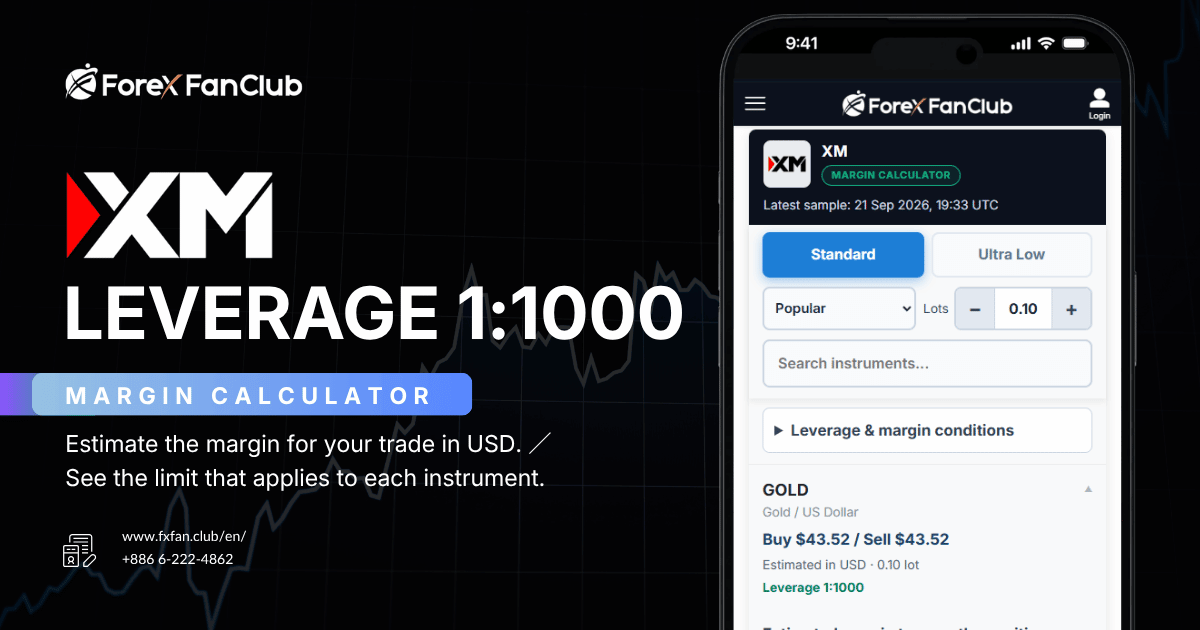
You can also check trading hours, dividend schedules, and expiry dates for XM financial instruments directly in the XM Members Area. And you can easily calculate the required margin in USD using XM’s Forex Calculator. We recommend using both tools together for the most efficient trading experience.
XM Trading Conditions Trade Size & Lot Conditions at XM
In the Forex market, trade size is expressed in units called “lots”. The lot size you choose has a direct impact on your risk management and profitability. XM offers a range of account types, each with a different standard lot size — giving traders the flexibility to start trading even with limited capital.
In this section, we’ll cover everything from the fundamentals of lot sizes and minimum/maximum trade sizes at XM, to the contract size specifications for each type of financial instrument — so you have the knowledge to size your positions effectively.
What Is a Lot in Forex Trading?
In Forex trading, a “lot” is the unit used to measure trade size. There are generally three types: Standard, Mini, and Micro.
| Type | Unit |
|---|---|
| Standard Lot | 1 lot = 100,000 currency units |
| Mini Lot | 1 lot = 10,000 currency units |
| Micro Lot | 1 lot = 1,000 currency units |
At XM, Standard and Ultra Low accounts use standard lots, whilst Standard Micro and Ultra Low Micro accounts use micro lots. This allows traders to adjust their lot size to match their trading style and capital size.
Minimum & Maximum Trade Sizes at XM
As explained above, trade sizes at XM vary by account type. Here are the minimum and maximum trade sizes for each:
- Minimum trade size: 0.01 lots (1,000 currency units)
- Maximum trade size: 50 lots per trade (5,000,000 currency units)
- Minimum trade size: 0.1 lots (100 currency units)
- Maximum trade size: 100 lots per trade (100,000 currency units)
The Micro account has a minimum trade size of 0.1 lots. However, for sizes above 0.1 lots, you can adjust in increments of 0.01 lots — enabling precise position sizing such as 0.11 lots, 0.12 lots, 0.25 lots, and so on.
Contract Sizes for Each XM Financial Instrument
XM has specific contract sizes defined for each type of financial instrument. The contract size is the standard trade volume per 1 lot, and it is used to calculate required margin and to convert spread values into USD. Understanding the contract size for each instrument helps you estimate potential profit and loss before placing a trade — enabling more effective risk management.
Here is an overview of contract sizes for the major instrument categories at XM:
The contract size for currency pairs varies by account type. For Standard and Ultra Low accounts, 1 lot equals 100,000 currency units — so trading 1 lot of USD/JPY means controlling a position equivalent to $100,000 USD. For Micro accounts, 1 lot equals 1,000 currency units, allowing you to trade the same pair at 1/100th the size.
Precious metals have unique contract sizes. GOLD is 100 troy ounces per lot, whilst SILVER is 5,000 troy ounces per lot — meaning the notional value can differ significantly even with the same number of lots. For example, trading 1 lot of GOLD at the current price of $3,000 USD represents a position worth approximately $300,000 USD.
Stock index contract sizes are typically expressed as a monetary value per point. For example, the Nikkei (JP225Cash) has a contract size of 1 JPY per lot — a 100-point move generates a profit or loss of 100 JPY. In contrast, US stock indices have a contract size of $1 USD per lot — a 100-point move results in a $100 USD gain or loss.
Energy contract sizes are based on physical delivery units. Crude oil is 100 barrels per lot, whilst natural gas is 1,000 MMBtu per lot — leading to significantly different notional values even at the same lot size. For example, trading 1 lot of oil at $70 USD represents a position worth approximately $7,000 USD.
Cryptocurrency contract sizes are defined based on each coin’s individual characteristics. Bitcoin — being high-priced — has a contract size of 1 BTC per lot. Ethereum is 1 ETH per lot. Ripple, with its lower price, is 1,000 XRP per lot. Contract sizes are generally scaled to the price range of each asset.
A solid understanding of contract size differences helps you accurately assess the “pip value in USD” and “required margin” for each instrument. Especially when trading non-currency instruments, understanding these differences allows you to fine-tune your lot size and manage risk with greater confidence.
We’ve introduced an overview of XM’s contract sizes here, but if you need the full contract size list for all instruments — and how to use them to calculate required margin — refer to the Complete XM Margin Guide below.
▼ Complete XM Margin Guide
You can also check trading hours, dividend schedules, and expiry dates for XM financial instruments directly in the XM Members Area. And you can easily calculate the pip value in USD using XM’s Forex Calculator — no manual contract size calculations needed. We recommend using both resources together for maximum efficiency.
XM Trading Conditions Frequently Asked Questions About XM Trading Conditions
We’ve compiled the most frequently asked questions about XM’s trading conditions — along with detailed answers — from traders of all experience levels. Topics cover key practical aspects of live trading, including how to change leverage, the characteristics of each account type, and how spreads work. We hope you find this section useful.
- Can I change my leverage at XM?
-
Yes. You can change your leverage by logging into the XM Members Area, navigating to “Home” → “Account Overview,” clicking “…” next to the relevant account, and selecting “Change Leverage.” Note that leverage cannot be changed whilst you have open positions. The change takes effect immediately.
- What is a Pip at XM?
-
A pip is the unit of measurement for price movement in the Forex market. For most currency pairs, 1 pip equals a change at the 4th decimal place (0.0001) — for example, EUR/USD moving from 1.0833 to 1.0834. For Gold (XAUUSD), 1 pip equals a change at the 1st decimal place (0.1).
- What type of spread does XM use?
-
XM uses floating spreads and a Market Making model for price formation. Since XM does not operate on an ECN/STP model, there are no separate trading commissions — all costs are built into the spread. Spread width varies depending on market liquidity and the time of day.
- How do bonuses differ across XM account types?
-
All Standard account types are eligible for all promotions — including the $30 Trading Bonus, Deposit Bonus, and the XM Loyalty Programme. Ultra Low accounts are not eligible for the Deposit Bonus only. The Shares account is not eligible for any bonuses.
- What is the XM Micro Account?
-
The XM Micro Account is an account type where 1 lot equals 1,000 currency units. On the MT4 platform, the minimum trade size starts at 0.01 lots (10 currency units), and on MT5 it starts at 0.1 lots (100 currency units). XM offers both Standard Micro and Ultra Low Micro account variants.
- Can I hold positions over the weekend at XM?
-
Yes, you can hold positions over the weekend at XM. However, when the market reopens on Monday, large price gaps may occur due to news or events that unfolded over the weekend. Exercise extra caution when holding positions over weekends with significant scheduled events.
- What are XM’s trading hours?
-
XM’s Forex trading hours run from Monday 00:05 to Friday 23:50 (UTC+2 server time). During summer time (DST), the server operates at UTC+3. Trading hours vary depending on the instrument type.
This guide has provided a comprehensive overview of XM’s trading conditions — covering account type comparisons, spreads, swap rates, leverage, margin, and trade sizing. Understanding the distinct characteristics of the Standard and Ultra Low accounts will help you select the right account for your trading style and capital. Furthermore, gaining a solid grasp of the spread and swap characteristics for each financial instrument will empower you to build more effective trading strategies. We recommend reviewing these conditions regularly to make the most of XM’s outstanding trading environment.
Financial Licence & Legal Information
XM is operated by XM Global Limited, registered with the Financial Services Commission (FSC) of Belize under the Securities Industry Act 2021 (Licence No. 000261/27).
Risk Warning
Trading Forex and CFDs involves a high risk of losing your invested capital. Please read and fully understand XM’s Risk Disclosure before trading.
Legal Documents — XM Global Limited
Company Name: XM Global Limited
Address: XM Global Limited, 63 Eve St, Belize City, Belize
Financial Instrument Trading Licence: Belize Financial Services Commission (FSC) Licence No. 000261/27
This website is operated by CHIHEWANLE Ltd. under a partnership agreement with XM (XM Global Limited) at the domain https://www.fxfan.club/. All personal data collected is held by XM (XM Global Limited).
Information Provider: CHIHEWANLE Ltd.
Registration No.: 24917404
Address: No.50 12F-3, Chenggong Rd, North District, Tainan City, Taiwan
- XM Trading Conditions Trading Conditions by Account Type
- XM Account Type Comparison Table
- How to Choose the Right XM Account Type
- XM Trading Conditions Spread Costs & Trading Conditions at XM
- Average Spread List for Key XM Instruments
- Key Characteristics of XM Spreads
- XM Trading Conditions Swap Rate Trading Conditions at XM
- Understanding Swap Rates in Forex Trading
- When Do Swap Rates Apply at XM?
- How to Calculate XM Swap Rates in USD
- About Swap-Free Accounts
- Swap Rate Table for Key XM Instruments
- XM Swap Rate Rankings
- XM Trading Conditions Margin & Leverage Trading Conditions at XM
- How Leveraged Trading Works
- How to Calculate Required Margin at XM
- Margin Call & Stop Out Mechanisms
- Maximum Leverage & Required Margin Table for Key Instruments
- XM Trading Conditions Trade Size & Lot Conditions at XM
- What Is a Lot in Forex Trading?
- Minimum & Maximum Trade Sizes at XM
- Contract Sizes for Each XM Financial Instrument
- XM Trading Conditions Frequently Asked Questions About XM Trading Conditions