
Why you practise on one or two markets, and how to choose the ones that move in your trading hours at a small cost.
Checked on 19 November 2026
In the last lesson, you saw the traps on the easy paths to quick money. From here, you take the other path and build your skill through your own practice. The first two things to decide are when you can sit at the chart every day, and what you will practise on during that time.
Here is the short answer. Practise on only one or two markets. A market here means anything you can trade, such as a currency pair, gold or a stock index.
Choose markets that meet two conditions. They move a lot in your trading hours, and their cost is small compared with how far the price moves. You do not need to know how they move yet. The pairs with the lowest spread, such as EURUSD and USDJPY, do not always meet these conditions.
This page is the fourth lesson of our free forex course.
Contents
- Why Should You Practise on Only One or Two Markets?
- How Are Markets Different from Each Other?
- Which Hours Can You Really Trade?
- Which Markets Move in Your Trading Hours?
- Why Can a Low-Cost Pair Still Cost You More?
- Do These Differences Stay the Same?
- How Do You Pick Your One or Two?
- Can You Change Your Choice Later?
- Questions About Choosing What to Trade
Why Should You Practise on Only One or Two Markets?
Every market moves in its own way, and you learn that way faster when you watch the same chart every day. If you spread your time over ten markets, weeks can pass before you learn how any one of them moves.
Reading a chart means knowing what a market tends to do after a certain pattern. When you see the same pattern on the same market dozens of times, you start to see the next move coming. So at the start, watch fewer markets and see more patterns on each one.
How Are Markets Different from Each Other?
Markets differ in six ways: how far they move, when they move, what moves them, how they move, what moves with them and what they cost. Each of these affects how easy a market is to practise on, and how much you win or lose on one trade.
- How far it moves Some markets move a lot in a day, and some hardly move. Over the last five days, gold moved about 1.9% of its price in a day, and EURUSD about 0.4%.
- When it moves Some markets move a lot only when the London or New York markets open, and stay quiet the rest of the day. The US stock indices move most when the New York stock market is open.
- What moves it Gold moves with US interest rates and the US dollar. US100 moves with the results of large US companies. EURUSD moves with news about interest rates in Europe and the US. In some periods, prices follow the patterns on the chart. In others, news moves them suddenly.
- How it moves Some markets tend to move in one direction for a long time, some often turn back soon after a move, and some often leave long wicks on the candles. You learn these habits by watching the chart yourself.
- What moves with it Some markets tend to move in the same direction as another market, such as US100 and US500, or EURUSD and GBPUSD. If you choose both, you practise almost the same thing twice, and you miss the chance to learn a different kind of move.
- What it costs The spread and commission that you pay on one trade are different on each market. What matters is the cost compared with how far the price moves, not the cost alone.
Which Hours Can You Really Trade?
Your trading hours are not the hours when the market moves most. They are the hours when you can sit at the chart every day, after work and without losing sleep. Watching the chart for one hour every day shows you more patterns than watching it at the busiest time only once a week.
Try to find a block of about three hours. In one hour, you see only a small part of the day’s price moves. The longer your block of time, the more often you can follow one move from start to finish. If you can only find one or two hours for now, start there, and choose a market that moves during that time.
Where your hours fall in the market’s day depends on your time zone. The Best Time to Trade page shows the Tokyo, London and New York sessions on your own clock. Its tool also shows, hour by hour, how far each market moves and how much one trade costs.
If you cannot find time on weekdays, you cannot practise forex trading, because the market is closed at the weekend. In that case, your time may be better spent on investing or an online business, which the first lesson looked at.
Which Markets Move in Your Trading Hours?
A market that is quiet during your trading hours gives you nothing to practise on. So choose from the markets that move a lot while you are at the chart.
The table below shows, for each part of the day, the three markets with the biggest move compared with their cost. The data comes from the Best Time to Trade tool.
| Part of the day | Biggest move for the cost |
|---|---|
| Asian hours, before London | Gold, US100, JP225 |
| London morning | Gold, US100, GER40 |
| London and New York both open | US100, Gold, US30 |
| New York afternoon | US100, US30, Gold |
At the moment, gold and the US stock indices are near the top in every part of the day. EURUSD, on the other hand, came only 9th or 10th out of 16 or 17 markets in each part of the day.
Why Can a Low-Cost Pair Still Cost You More?
On a market that hardly moves, the cost takes a bigger share of your profit, even when the cost is low. So compare the cost with how far the market moves in a day, not the cost alone.
The table below compares the average day’s move over the last five days with the usual cost of one trade, from our ranking tool.
| Market | Price move / cost | Ratio |
|---|---|---|
| Gold | $70 / $0.12 | 568× |
| US100 | 626 / 1.4 points | 463× |
| EURUSD | 42 / 0.6 pips | 77× |
| USDJPY | 45 / 0.9 pips | 49× |
For example, imagine a trade that catches a quarter of the day’s move. On EURUSD, the cost takes about 5% of that profit, and on USDJPY about 8%. On gold, it takes less than 1%. So with the same skill and the same kind of trade, you keep less of your profit on EURUSD.
This is why choosing EURUSD just because its spread is the lowest can cost you money. The ranking of markets by move for their cost compares more than 40 markets in the same way.
Do These Differences Stay the Same?
No, they change. A market that moves a lot today may become quiet in a few years.
Gold is an example. From 2017 to 2019, gold moved only 0.7% to 0.8% of its price in an average day, which was about $9 to $11 an ounce. So far in 2026, it has moved about 2.7% in an average day, or about $122 an ounce.
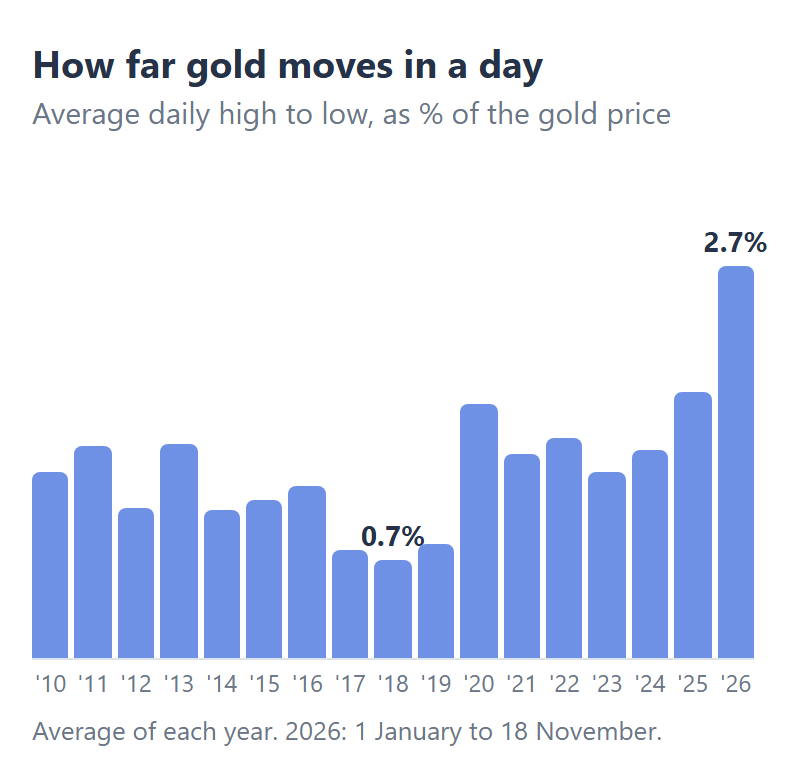
Measured in percent of the price, gold moved less than twice as much as EURUSD in a day in 2019. So far in 2026, it has moved more than five times as much. So check your choice against the ranking every few months.
How Do You Pick Your One or Two?
Pick one or two markets that meet both of these conditions.
- It moves a lot in the hours when you can sit at the chart.
- Its cost is small compared with how far the price moves in a day.
If you pick two, avoid two markets that tend to move in the same direction, such as US100 and US500. Otherwise you practise almost the same thing twice.
You do not need to know how a market moves at this point. You learn its habits slowly, by watching the same chart for a long time. So you learn them later, through practice on the charts of the markets you pick now.
With today’s numbers, gold and US100 meet both conditions in most parts of the day. However, this only describes the market today, and we are not recommending these two.
When you choose a market that moves a lot, watch your lot size. On a market that moves far, the same lot size loses more money on one trade. Work out your lot size from the distance to your stop loss with the lot size calculator.
Also, if news comes out over the weekend while the market is closed, the first price on Monday can be far from the last price on Friday. Your stop loss may then close the trade at a worse price than the one you set.
Can You Change Your Choice Later?
Yes. Your first choice is only a starting point. If the hours or the way the market moves do not suit you after a few weeks of practice, change it. And if your market starts to move differently later on, look again.
However, if you switch markets after every losing day, you never learn how any of them moves. Base the decision on a few weeks of notes, not on the result of one day.
In the next lesson, you compare brokers and trading accounts by what they cost on the markets you chose.
Questions About Choosing What to Trade
- Should a beginner trade many pairs at the same time?
-
We do not recommend it at the start. Experienced traders sometimes compare how strong each currency is. For example, when the euro is strong, they trade it against the weakest currency at the time.
That comes after the basics. First, learn to read one or two markets and trade them by your own rules, and then add more.
- Is gold good for beginners?
-
At the moment, gold moves a lot in most hours of the day, and its cost is small compared with how far the price moves. However, because gold moves so far, the same lot size can lose more money than on a currency pair.
If you practise with small lot sizes, gold is worth considering.
- Can you practise on crypto at the weekend?
-
If you already trade crypto such as BTCUSD during the week, yes.
If you trade other markets during the week, we do not recommend it. Crypto is moved by different news and moves in a different way, so practising on crypto at the weekend does little for your weekday trading.
Crypto also moves less at the weekend. Over the last year, BTCUSD moved only about 60% as far on a weekend day as on a weekday. So at the weekend, the cost is larger compared with how far the price moves.
Once your rebate account is open, link it to Forex FanClub. The member area lists every rebate payment day by day, across every broker you use. Registration is free and takes an email address.

Produced and operated by Forex FanClub
Person responsible: Hiroki Sakaida, founder of Forex FanClub
Hiroki Sakaida decides what our content and services cover and which features they offer. He also checks content and functionality and decides on revisions and publication. Our Content and Service Policy explains how we produce and check our content and services, including our use of AI.
Risk warning: Forex and CFD trading involve leverage, and you could lose all the money you invest. This article and tool provide information, not investment advice. The amounts shown are calculated from the collected data and do not guarantee the amounts that will apply to your own trades, or any future profit.
Affiliate disclosure: The broker pages linked from this page contain referral links. Forex FanClub receives referral commission based on registrations and trading through those links.
- Why Should You Practise on Only One or Two Markets?
- How Are Markets Different from Each Other?
- Which Hours Can You Really Trade?
- Which Markets Move in Your Trading Hours?
- Why Can a Low-Cost Pair Still Cost You More?
- Do These Differences Stay the Same?
- How Do You Pick Your One or Two?
- Can You Change Your Choice Later?
- Questions About Choosing What to Trade