
Five ways to grow your money, from the most stable to the biggest risk and return, and where forex fits among them.
Checked on 18 November 2026
At school, you learn only one way to earn money. You study hard, get a good job and earn a salary. That way is safe, but it is only the basic way, and it is not the best way.
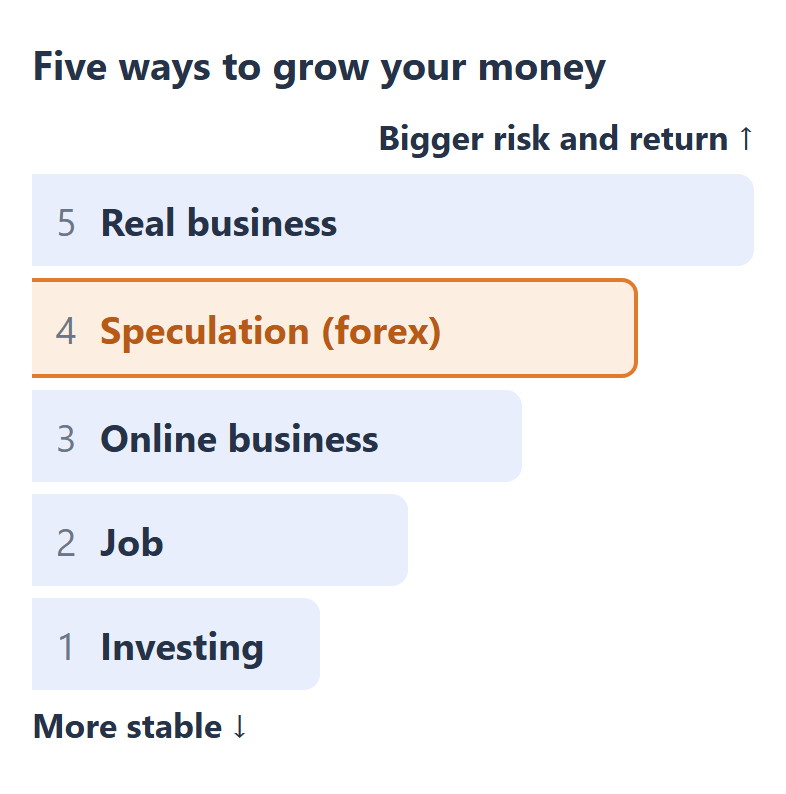
In fact, there are five ways to grow your money, from the most stable to the ones with the biggest risk and return. The fourth way is speculation, and forex trading is one kind of speculation. You can start forex with a small amount of money and no degree, and with the right practice it can change your situation quickly. So before your first trade, let’s see where forex sits among the five ways and which money belongs in forex.
This page is the first lesson of our free forex course, which takes you from here to daily practice in six stages.
Contents
Where Does Money Come From?
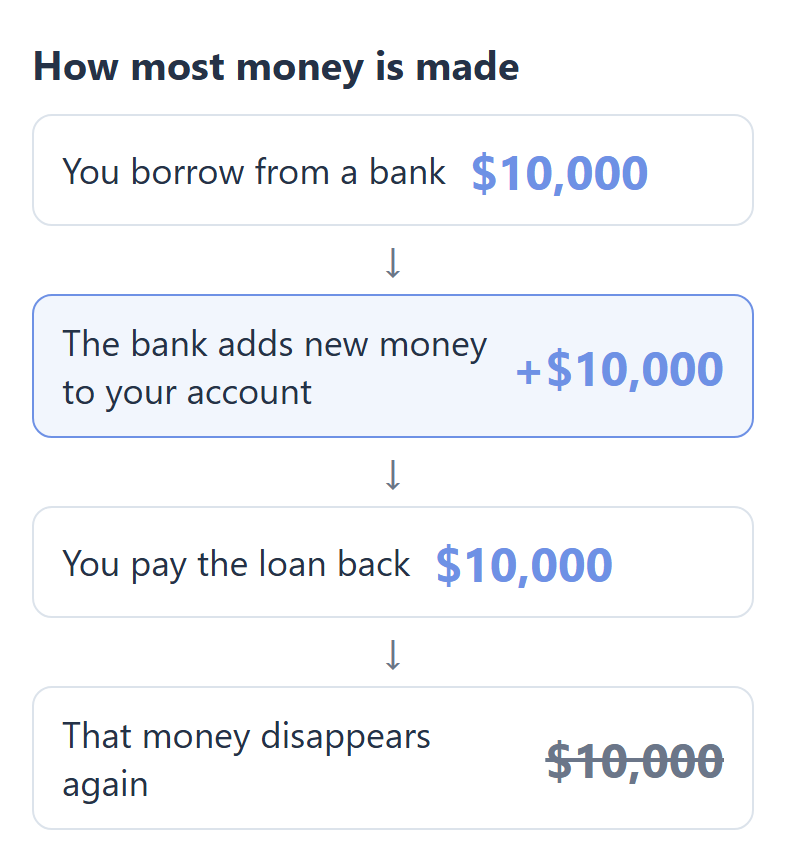
Did you know that most of the money in the world is created the moment someone borrows from a bank? When a bank lends you $10,000, the bank does not take that money from someone else’s savings. The bank simply types $10,000 into your bank account, and that money did not exist a second before.
It also works the other way. When a loan is paid back, that money disappears again, so if every debt in the world were repaid, most money would disappear with it. Money has no value of its own. A banknote is worth something only because everyone agrees to accept it.
Today’s economy keeps going only while people keep borrowing to build new homes, factories and businesses, so the total amount of money keeps growing. That is why one US dollar in 1926 bought about as much as $19 buys today.
So here is the hard truth. If you only hold cash, its value slowly melts away over the years. To keep the value of your money, you need to keep it in things whose value rises as the total amount of money grows, such as good businesses, precious metals like gold, and land. This will keep happening for as long as the economy runs on borrowed money in this way.
School rarely teaches this truth about money, but every way to grow money starts from it. So with this truth in mind, let’s look at the five ways to grow your money.
What Are the Five Ways to Grow Your Money?
From the most stable to the biggest risk and return, the five ways are investing, a job, an online business, speculation and a real business. Each way uses the money system in a different way, so each one asks for a different mix of money, time and skill.
Investing
When you invest, you own part of the businesses that borrow the new money and use it to grow. As the total amount of money grows, the value of those businesses grows with it, so your money works for you without your time or skill. Gold and land work in a similar way. There is only so much gold and land, so over long periods their prices have risen as more money was created.
The S&P 500, an index of 500 large US companies, has grown by about 7% a year on average since 1928, after inflation and with dividends included. At 7% a year, your money doubles in about 10 years. The companies in the index use the growing money to grow, so a fund that simply follows the index has been the most stable way to grow money.
Remember, past growth is a record, not a promise. In 2008, for example, the index fell hard in a single year. So give your investments time. Keep the money that you will need in the next few years in your savings, and invest only the money that you can leave alone for many years.
A Job
A job pays you a salary from a company that runs on borrowed money. This is the way that school teaches, and it is a sound base because the salary comes every month. However, your salary is paid in cash, and cash slowly loses its value. So a job alone grows your money slowly, and part of each salary belongs in investing.
Many people start forex because they want to leave their job one day. However, if you quit your job to trade forex for a living, your rent has to come from your trades. Then fear and hurry make your decisions for you, and you start taking trades that you cannot afford to lose. So keep your job while you learn forex. Your salary pays for the months of practice, and you can think about your job again once your practice shows a positive total.
An Online Business
An online business, such as a website or a small online shop, earns from money that people already spend. You usually need no bank loan, only your time and skill, so you lose little money if it fails. The income grows with the number of customers, but building it takes months of work before it earns.
Speculation
Speculation means buying and selling to earn from price moves. Forex trading is one kind of speculation, and this course teaches forex trading. Speculation creates no new money. Across the whole market, before costs, the profits of some traders and the losses of others cancel out, so your skill decides your result far more than the size of your money.
In forex, exchange rates move because each country creates its money at a different speed and sets a different interest rate, and traders trade that movement. Forex needs some money to start, but far less than a real business, so you can begin with a small amount.
A Real Business
A real business, such as a restaurant or a factory, usually starts with a bank loan. That loan is exactly how new money is created, so a real business sits at the centre of the money system. When the business succeeds, it can earn more than any of the other four ways. When it fails, the loan still has to be paid back, so a real business also brings the biggest risk.
Is Forex Trading Gambling?
Forex turns into gambling the moment you trade with money that belongs to the other ways, such as the salary that pays your rent or the money for your investments.
So put into forex only money that you could lose completely without changing your rent, your food, your savings for emergencies or your investments. If losing the money would change any of those, fear and hurry take over your decisions, and every trade becomes a bet, however good your analysis is.
The other difference is how you decide. A gambler places a bet and hopes. A trader decides the loss before entering the trade, keeps that loss small, and enters only when the chart shows what other traders are likely to do next. Reading the chart in this way is a skill, and you build that skill through practice.
So whether forex is gambling depends on the money that you use and on how you decide. Most people who start forex get both wrong, and that is why forex is known as high risk.
Is Forex Really High Risk?
Forex is high risk for people who trade like gamblers. The right way to practise is hard to find, fake mentors and scams are everywhere, and anyone can open a trading account with a few dollars, so most people start without any training.
Untrained traders make the same mistakes again and again. They trade too big, they move their stop loss when the price goes against them, and they try to win back a loss at once. Many of them come because an advert says that an EA or a signal service makes winning easy, and they trust the advert instead of their own skill. A trader who has practised avoids those mistakes, and that alone gives a real advantage over most traders.
So “high risk, high return” is a warning for the general public. For a trader who has practised the right way, the risk on each trade is small and decided before the trade, so forex can become a way to aim for a high return with a low risk.
You do not need big savings, a degree or a special talent. Forex asks only for the right practice. Most people never do that practice, and that is exactly where your chance is.
How Do You Get Stronger at Forex, Step by Step?
You get stronger when you learn to read what other traders are thinking from the chart, and then you practise entries and stop losses in a trading simulator every day until your total is positive.
A trading simulator is software that replays past prices so that you can trade them by hand, and you can go through months of trades in a few weeks. If you want to earn from forex, do not rely on an EA or a signal that someone else built, because you cannot fix a method that you do not understand.
If you want to trade automatically, the fastest way is to understand manual trading first and then build your own EA. Today, AI can write the code for you, so anyone can build an EA without knowing how to program. Before you use your EA, you test it in the Strategy Tester that comes with MT5. That tester runs your EA on past prices, so it is a different tool from the simulator that you use for manual practice.
Our free forex course takes you through six stages, in this order:
- Before you start
How to grow your money, and where forex fits (this page) - Your trading style
Manual trading, EAs or semi-automated trading, and the scams on the easy paths - Your hours and instruments
The hours you can watch the chart, and the instruments that move in those hours - Your trading setup
A broker and trading account, MT5 and the tools, and what to do with only a phone - Reading the chart
What each candle says about buyers and sellers, and how to read chart patterns - Practice
Entries and stop losses in a trading simulator, every day, until your total is positive
So let’s take the next step and decide what kind of trader you want to be.
Questions About Starting Forex
- Is forex trading profitable?
-
Forex trading can be profitable for traders whose method stays positive over hundreds of trades. Staying positive takes practice, so a new trader’s first target is a positive total after many practice trades, not a profit in the first month.
- Is forex a scam?
-
No, forex is not a scam. The forex market is real, and banks, companies and traders exchange currencies in the forex market every day. Some scams use the name of forex. For example, people ask you to send money so that they can trade for you, or companies offer trading without a licence. Before you open a trading account, check that the broker holds a licence from a financial regulator.
Where the figures come from
- How money is created
- Bank of England, Money creation in the modern economy (opens in a new tab) (2014). Whenever a bank makes a loan, it creates a matching deposit in the borrower’s account, and repaying a loan destroys that money. Bank deposits are 97% of the money in circulation in the UK.
- One dollar in 1926
- US consumer prices (CPI-U) in October 1926 and October 2026, from the US Bureau of Labor Statistics through FRED (opens in a new tab). Prices rose about 19 times.
- About 7% a year
- The S&P 500 with dividends grew by 10.0% a year from 1928 to 2025 (Aswath Damodaran, NYU Stern (opens in a new tab)). After US inflation of 3.0% a year, that is 6.8% a year. At 7% a year, money doubles in about 10.2 years.
Checked on 18 November 2026.
Once your rebate account is open, link it to Forex FanClub. The member area lists every rebate payment day by day, across every broker you use. Registration is free and takes an email address.

Produced and operated by Forex FanClub
Person responsible: Hiroki Sakaida, founder of Forex FanClub
Hiroki Sakaida decides what our content and services cover and which features they offer. He also checks content and functionality and decides on revisions and publication. Our Content and Service Policy explains how we produce and check our content and services, including our use of AI.
Risk warning: Forex and CFD trading involve leverage, and you could lose all the money you invest. This article and tool provide information, not investment advice. The amounts shown are calculated from the collected data and do not guarantee the amounts that will apply to your own trades, or any future profit.
Affiliate disclosure: The broker pages linked from this page contain referral links. Forex FanClub receives referral commission based on registrations and trading through those links.