
You can lose 8 trades out of 10 and still make money, if your wins are much bigger than your losses.
Checked on 23 November 2026
A trading method that wins 9 trades out of 10 can still lose you money. And a method that wins only 2 trades out of 10 can make money.
The difference is how big your wins are compared with your losses. This is called the risk reward ratio.
This lesson shows, with numbers, why we suggest cutting your losing trades small and letting your winning trades run.
This page is the tenth lesson of our free forex course.
Contents
- Why Are Small Losses and Big Wins Better Than a High Win Rate?
- What Is the Risk Reward Ratio, and What Win Rate Do You Need?
- Why Do Signal Users Find It Hard to Make Money?
- Where Do You Put a Small Stop Loss and a Big Take Profit?
- When the Trade Is Right, How Far Should You Let It Run?
- Can You Let Profits Run With Only 2 or 3 Hours at the Chart?
- How Long Are the Losing Streaks?
- How Do You Check Your Risk Reward Ratio in a Simulator?
- Questions About the Risk Reward Ratio
Why Are Small Losses and Big Wins Better Than a High Win Rate?
Because your total result depends on the size of your wins compared with your losses, not on your win rate. With small losses and big wins, you can lose 8 trades out of 10 and still end well above zero, because 2 big wins pay back all the losses and more.
| 10 trades | Win rate 90% Win $5, loss $60 | Win rate 20% Win $200, loss $20 |
|---|---|---|
| Total profit | +$45 | +$400 |
| Total of losses | −$60 | −$160 |
| Result | −$15 | +$240 |
We suggest small losses and big wins for three reasons.
You Can Cut a Losing Trade Without Hesitation
When one loss wipes out many wins, each stop loss gets harder to accept. So you keep the losing trade open, and in the end you take one very big loss. With small losses and big wins, each loss is small, so you can close it without doubt.
In our experience, a high win rate strategy becomes hard to trade when it starts to win a little less often. If you trade with small losses and big wins, you can also buy more on the trades that are already running far. Then each loss is even smaller compared with your big wins, and a stop loss no longer hurts.
You Catch More Pips in Total
Research (opens in a new tab) shows that when a market is moving in one direction, it tends to keep moving in that direction. Big moves also come together in a few short periods. If you always take profit early, you give up those moves every time.
For example, one study of real trades (opens in a new tab) found that 61% of EURUSD trades closed with a profit. But the average win was 48 pips and the average loss was 83 pips, so the traders lost money overall.
In our experience, the higher the win rate of a way of trading, the fewer pips it brought in overall. The lower we let our win rate go, the more pips we made in total.
You Pay Less in Spreads
When you let a trade run, you hold it longer, so you make fewer trades than when you buy and sell often for small moves. You pay the spread on every trade, so fewer trades means you pay less in total.
For example, with a gold spread of about $0.2, if you take a $20 move in 10 trades of $2 each, you pay $2 in spreads, which is 10% of the profit. If you take the same $20 move in one trade, you pay $0.2, which is 1% of the profit.
The Cost Is Longer Losing Streaks
With small losses and big wins, you lose more often, so your losing streaks are longer. If you make 100 trades with a 20% win rate, there is about a 50% chance that you lose 15 trades in a row at some point. We look at how to prepare for losing streaks later in this lesson.
What Is the Risk Reward Ratio, and What Win Rate Do You Need?
The risk reward ratio compares the distance to your stop loss with the distance to your take profit. With a stop loss $2 away and a take profit $20 away, the ratio is 1:10.
The ratio changes with each trade, so over many trades, you compare your average win with your average loss. In this lesson, your average loss is called 1R.
The bigger the ratio, the lower the win rate you need to break even.
| Risk reward ratio | Break-even win rate |
|---|---|
| 1:0.5 | 67% |
| 1:1 | 50% |
| 1:2 | 33% |
| 1:3 | 25% |
| 1:5 | 17% |
| 1:10 | 9% |
As the table shows, with a risk reward ratio of 1:10, you make money when your win rate is above 9%. We traded currency pairs that move less than gold, with an average loss under 10 pips and an average win of 100 to 200 pips, and we won about 2 trades in 10.
When your win rate goes up, your risk reward ratio usually goes down. If you put your take profit close and your stop loss far away, you win more often, so your win rate goes up. But your wins get smaller compared with your losses. So a high win rate alone does not tell you whether a way of trading makes money.
Your win rate depends on how well you read the chart, and it takes practice to raise it. Your risk reward ratio is different. You can change it today, because you choose where to put your stop loss and your take profit.
Why Do Signal Users Find It Hard to Make Money?
Because a signal tells you when to open a trade, but not the place where you know your idea was wrong. If you do not know that place, your stop loss is just a guess, or you have no stop loss and wait for the price to come back.
Cut the trade when it is wrong, and let it run when it is right. That is enough to make money overall, and it is not hard. People who rely on signals cannot set a stop loss because they cannot see, on the chart, the place where the trade is wrong.
With the way you read charts in this course, that place is clear. As you saw in the lesson on how to read forex charts, you put your stop loss where the trapped traders’ idea fails, which is where you know your own idea was wrong. Past that price, your reason for the trade is gone, so you can close it without doubt.
Signals and tools that advertise a high win rate rarely tell you how big their losses are. The win rate alone does not tell you whether a signal makes money overall.
Where Do You Put a Small Stop Loss and a Big Take Profit?
You choose your entry and your stop loss on the small time frame, and your take profit on the big time frame. In the last lesson, you planned on the 1-hour chart and traded on the 1-minute chart. If you trade that way, you get a big ratio without forcing it.
In Situation A of the last lesson, the price was rising from the bottom of a 1-hour range, and you bought after a false break on the 1-minute chart. Your stop loss went just below the low of the false break, so it was only as wide as a 1-minute move. Your take profit was the top of the range, as far away as a 1-hour move.
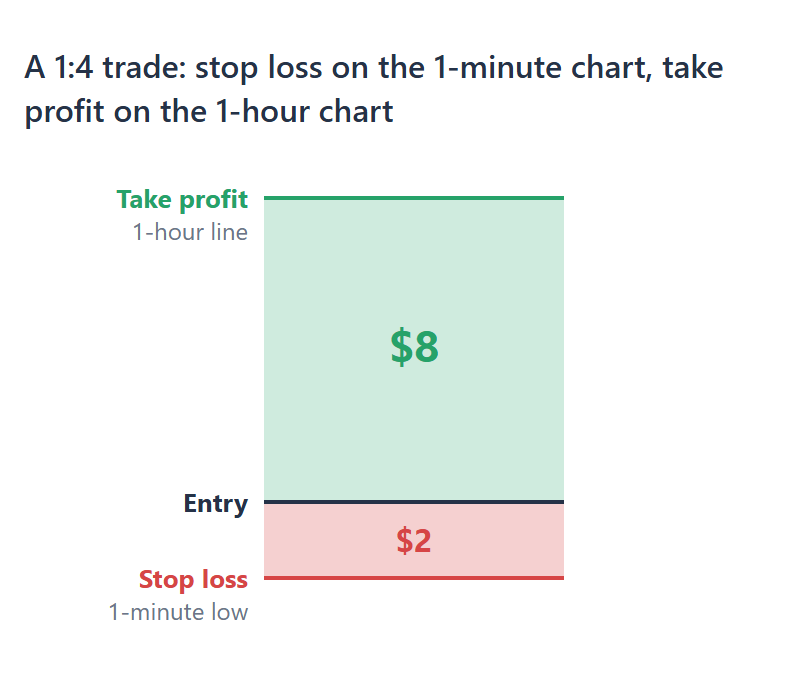
For example, on gold, your stop loss is $2 away and the top of the range is $8 away. That is a ratio of 1:4. With this ratio, you make money if you win more than one trade in five. If the price breaks out of the range and you can follow the trend, the same $2 stop loss can catch $20 or more, a ratio above 1:10.
You do not have to set your take profit at a price. Nobody knows how far the price will go, so closing the trade at a set time is also a good way to let a winning trade run. What matters is a small stop loss on the small time frame. Then your risk reward ratio is big whether you take profit at a line on the 1-hour chart or close the trade at a set time.
When the Trade Is Right, How Far Should You Let It Run?
Where you take profit is your own choice. But winning more than you lose on each trade makes it easier to make money overall, and easier to keep going.
A good target is a line on the 1-hour chart, as in the last lesson. Traders who get trapped next keep their stop losses beyond that line, so the price often moves there. When there is no line in the way, as in Situation D, hold the trade for as long as the price keeps going.
When a trade is in profit, you want to close it and feel safe. Every trader feels this. But if you always do it, your wins stay small and your losses stay at 1R, so your average win gets smaller compared with your average loss.
Can You Let Profits Run With Only 2 or 3 Hours at the Chart?
Yes. When you leave the screen, keep the trade open and let a tool close it for you. Two or three hours after work are not enough to catch a big move, and big moves often come after you have left the screen.
PidPro is a tool on your MT5 chart that closes your positions when a condition you set is met. Before you leave the screen, you turn on its four automatic closes.
- Break Even closes a trade that was in profit when the price comes back to your entry price.
- Trailing Close closes a trade when the price falls back from its best level by a distance you set.
- Time Close closes your trades at a time you set.
- Pips Close closes your trades when the profit or loss reaches the pips you set.
Then, if the price runs and comes back while you are away, the trade does not end in a loss. If the price runs far, you keep most of that profit.
PidPro runs inside MT5, so keep MT5 open while you are away. To install PidPro and set its four automatic closes, see the lesson on MT5 and trading tools.
You can also add to a trade that is already running far. Some traders buy more at the start of a move, or when the price moves sideways for a while inside a trend. This is called pyramiding.
Most of the profit from small losses and big wins comes from a few trades that run far, so pyramiding fits this way of trading well. We look at how to add to a trade in the lessons on money management.
How Long Are the Losing Streaks?
If you make 100 trades with a 20% win rate and wins 10 times as big as losses, there is about a 50% chance that you lose 15 trades in a row at some point. Your biggest drop is usually around 15R.
Even with a 40% win rate and wins twice as big as losses, there is about a 50% chance that you lose 8 trades in a row. These long losing streaks are the cost of small losses and big wins.
A higher win rate gives shorter losing streaks. The table below compares two ways of trading that end with the same total after 100 trades. We ran 100 random trades 20,000 times for each one.
| In 100 trades | Win rate 40% Ratio 1:2 | Win rate 70% Ratio 1:0.7 |
|---|---|---|
| Total (average) | +20R | +20R |
| Longest losing streak | 7 | 3 |
| 8 losses in a row | Half of the time | Almost never |
| Biggest drop | 10R | 4R |
| Below zero at trade 10 | 38% | 15% |
On the numbers alone, the way of trading with a 70% win rate has losing streaks and drops that are less than half as big. We still suggest small losses and big wins, for the three reasons at the start of this lesson. Your losing streaks are longer, but each loss is small, so taking each loss does not hurt.
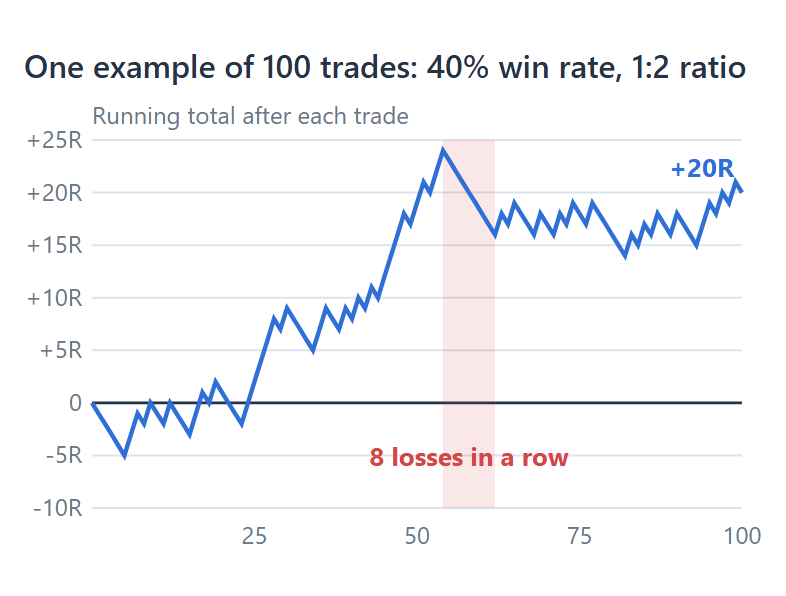
So do not judge your way of trading on 10 or 20 trades. As the table shows, even a way of trading that makes money overall is below zero after 10 trades in almost 4 cases out of 10. Look at your results in blocks of 100 trades.
To keep trading through a losing streak, use a lot size where one loss is a small part of your account. Set your lot size by how much the instrument usually moves. Enter the distance to your stop loss and the amount you can lose on one trade, and the lot size calculator shows your lot size.
How Do You Check Your Risk Reward Ratio in a Simulator?
Make 100 trades in a trading simulator, then look at your win rate, your average win and your average loss. Your average win divided by your average loss is your risk reward ratio.
Some simulators show your risk reward ratio and a number called the profit factor on the results screen. The profit factor is the money from all your wins divided by the money from all your losses.
If your simulator does not show these numbers, it takes more work, but you can record the profit or loss of each trade in our trading journal and get the numbers there.
If your total is still below zero, the fix depends on what is missing. If your win rate is too low, practise reading the chart again. If your ratio is too small, you are taking profit too early or putting your stop loss too far away.
We look at how to practise on past charts in the next lesson.
Questions About the Risk Reward Ratio
- What Is a Good Risk Reward Ratio?
-
There is no single right number. Look at the ratio together with your win rate.
With a risk reward ratio of 1:2, you make money when your win rate is above 33%. With 1:3, you make money when it is above 25%.
If you choose your entry and stop loss on a small time frame and your take profit on a big one, a ratio of 1:2 or more comes naturally.
- Is a High Win Rate Strategy Bad?
-
No. When two ways of trading make the same total, the one with the higher win rate has shorter losing streaks.
But every way of trading needs a stop loss. The smaller your wins, the more easily one loss you did not cut, or your trading costs, can turn your total negative.
- What Does a 1:3 Risk Reward Ratio Mean?
-
It means you aim to win three times the distance to your stop loss. With a stop loss 10 pips away, your take profit is 30 pips away.
With this ratio, you make money if you win more than one trade in four.
Once your rebate account is open, link it to Forex FanClub. The member area lists every rebate payment day by day, across every broker you use. Registration is free and takes an email address.

Produced and operated by Forex FanClub
Person responsible: Hiroki Sakaida, founder of Forex FanClub
Hiroki Sakaida decides what our content and services cover and which features they offer. He also checks content and functionality and decides on revisions and publication. Our Content and Service Policy explains how we produce and check our content and services, including our use of AI.
Risk warning: Forex and CFD trading involve leverage, and you could lose all the money you invest. This article and tool provide information, not investment advice. The amounts shown are calculated from the collected data and do not guarantee the amounts that will apply to your own trades, or any future profit.
Affiliate disclosure: The broker pages linked from this page contain referral links. Forex FanClub receives referral commission based on registrations and trading through those links.
- Why Are Small Losses and Big Wins Better Than a High Win Rate?
- You Can Cut a Losing Trade Without Hesitation
- You Catch More Pips in Total
- You Pay Less in Spreads
- The Cost Is Longer Losing Streaks
- What Is the Risk Reward Ratio, and What Win Rate Do You Need?
- Why Do Signal Users Find It Hard to Make Money?
- Where Do You Put a Small Stop Loss and a Big Take Profit?
- When the Trade Is Right, How Far Should You Let It Run?
- Can You Let Profits Run With Only 2 or 3 Hours at the Chart?
- How Long Are the Losing Streaks?
- How Do You Check Your Risk Reward Ratio in a Simulator?
- Questions About the Risk Reward Ratio