
Practise on past charts, and you can go through half a year of price action in about two weeks.
Checked on 25 November 2026
Your eye for reading charts grows with the number of times you make a decision and then see whether it was right. But in live trading, you spend far more time waiting for a setup than trading it, so you make few of these decisions.
There is a much faster way to build it up. You go through past charts, bar by bar or at high speed, and you place your own entries and stop losses again and again. In about two weeks, you can practise on half a year of price action.
This lesson shows why this kind of practice trains your eye faster than anything else, and how to start.
This page is the eleventh lesson of our free forex course.
Contents
- Why Is Backtesting by Hand the Fastest Way to Get Better at Trading?
- What Is Backtesting in Trading?
- What Do You Repeat in Each Practice Trade?
- Which Charts Should You Practise On?
- What Lot Size and How Many Positions Should You Use in Practice Trades?
- How Long Should You Keep Practising?
- Which Backtesting Software Should You Use?
- How Do You Set Up the Chart for Practice?
- If You Win in Practice, Will You Win in Live Trading?
- Questions About Backtesting
Why Is Backtesting by Hand the Fastest Way to Get Better at Trading?
Because your eye for reading charts grows by making hundreds of decisions yourself and checking each one, and practice on past charts is the fastest way to make that many.
We can move through 3 hours of the 1-minute chart in 30 minutes at most, even while we draw lines and think. So with 3 hours of practice a day, you go through about a week of live trading in one day.
If you practise longer at the weekend, when you have more time, you can go through half a year of price action in about two weeks.
You need that many trades because, even when you read the chart well, a small number of trades can still end in a loss. We ran 20,000 random runs for a trader with a 40% win rate and a risk reward ratio of 1:2.
| Trades | Chance that your total is a loss |
|---|---|
| 20 | 25% |
| 100 | 9% |
| 200 | 2.5% |
So even when you read the chart well, 1 run in 4 is still below zero after 20 trades. Your skill shows clearly in the numbers only after about 200 trades.
In live trading alone, it takes a long time to get there, and many traders stop trusting their way of reading the chart after a few losses and change it. On past charts, you reach 200 trades much sooner, so you see your real numbers before you change anything.
Over hundreds of trades, you also learn more than how to read the chart. You learn things like these from your own results, not from a book:
- Losses always come, however well you read the chart.
- What counts is your total, not each trade.
- Why you need a stop loss. One trade that you did not cut can wipe out many wins.
- Which chart patterns you read well and which ones you do not, so you can skip the weak ones or take more care with them.
Most beginners carry bits of market knowledge from books and videos, and the bits do not connect. As you keep practising, there comes a moment when they join up and you think, “So that is why the price moves like this.” It is rare to get that moment from a few live trades now and then.
Practice also gives you the answer right away, and it costs you no money. You can even go through the long losing streaks from the last lesson before you trade live.
What Is Backtesting in Trading?
Backtesting means going back to past charts and checking what would have happened if you had traded them. In this course, you do it by hand: you move the chart forward one bar at a time and decide your entries and stop losses yourself.
What this course has cared about so far is the skill of reading the chart, not a fixed method. When you practise by hand, you decide hundreds of times who is trapped and where they give up, as in the lesson on how to read forex charts. That is how the skill itself gets stronger.
What Do You Repeat in Each Practice Trade?
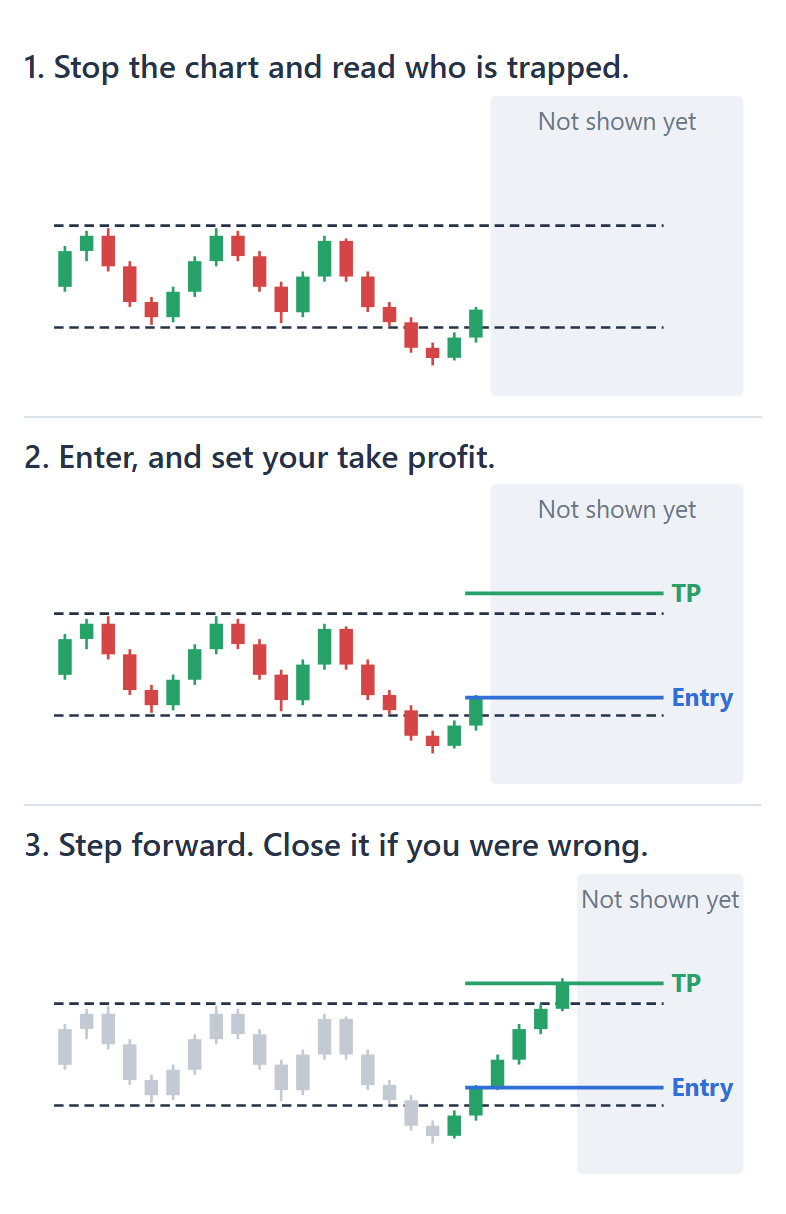
One practice trade is this: you plan a scenario on the 1-hour chart, enter on the 1-minute chart, and move forward until you close the trade, either because your idea turns out wrong or because the price reaches your take profit. It puts the last three lessons together into one routine.
- Look at the 1-hour candlestick chart. See which traders are trapped and where, and plan a scenario.
- On the 1-minute chart, enter where the trapped traders start to give up.
- Put your take profit at a line on the 1-hour chart.
- Move the chart forward. As soon as you see that your idea was wrong, close the trade. You do not need to set that price in advance. For example, one candle that closes on the wrong side of your line can be enough.
- If your idea stays right, hold the trade until the price reaches your take profit.
Nobody can follow this routine well at the start, and we could not either. You enter in the wrong place, you take a big loss because you did not set a stop loss, and you close a trade too early and miss the move.
On past charts, you can make all these mistakes again and again without losing money, and each time you get a little stronger.
Which Charts Should You Practise On?
The last six months, or even the last three, are enough. Price action changes a lot from year to year, so in 2026, practice on a 2020 chart does little for the market you trade today.
You can go through the same months so many times that you start to remember the moves. That is fine. When you know the period that well, you learn how your symbol moves now: where it tends to stop, and how far it tends to run.
If you later want to see how the market has changed over the years, you can practise on older charts at any time. Start with the most recent months, because they are closest to the market that you will trade.
What Lot Size and How Many Positions Should You Use in Practice Trades?
Keep the same lot size on every trade, and hold only one position at a time. Then you can tell whether your result comes from your chart reading or from changes in your lot size.
If you change your lot size after wins and losses, or add to a trade while it is open, your total mixes two things: your skill at reading the chart and the way you move your money. In your practice trades, you only want to measure the first one.
With a fixed lot size, your biggest drop during a losing streak, which is called the maximum drawdown, also sets an upper limit for your lot size later. We look at how to read that number in the lesson on maximum drawdown, and at raising your lot size and adding to trades in the money management chapter.
How Long Should You Keep Practising?
Practise every day until your total is above zero. Judge your results every 100 trades.
Practising every day matters, because a gap throws off your feel for the chart. For us, even one day off was enough, and the chart looked a little different at first. The longer the gap, the bigger the change.
Research on how people forget skills (opens in a new tab) found the same thing: the longer you do not use a skill, the more you lose it, and thinking skills fade faster than physical ones. Reading a chart is a thinking skill.
Do not change how you read the chart after 10 or 20 trades. As the first table shows, losses often come first, even when you read the chart well.
If you are still below zero after 100 trades, check whether your win rate or your risk reward ratio is too low, as in the last lesson. If your win rate is too low, work on your chart reading. If your ratio is too small, you are taking profit too early or putting your stop loss too far away. Change only one thing at a time.
Which Backtesting Software Should You Use?
You practise in backtesting software that runs in your web browser. It moves past prices forward one candle at a time or at high speed, and you trade them by hand. Three well-known ones are Forex Tester Online, FX Replay and TradingView, which has a Bar replay feature that plays back past prices.
Each of them has a free version or a free trial, and the paid plans start at about $15 a month. Backtesting software gets new features every year, so we do not pick the best one.
Try the free versions, and choose the one where drawing lines is easy and the playback speed works the way you want. Today’s prices are in the table in our lesson on trading forex with only a phone.
The Strategy Tester that comes with MT5 is not made for practising by hand. The MT5 app on your phone cannot play back past prices at all.
How Do You Set Up the Chart for Practice?
Open the symbol and the hours that you will trade live, and show the 1-hour chart and the 1-minute chart side by side. That is all you need to start practising today.
Use the one or two symbols that you chose earlier. We explain how to choose them in the lesson on how many pairs to trade. Practise at the hours when you can watch the chart in live trading. Add the 5-minute and 15-minute charts too, so you can follow the price from the big picture down to your entry point.
At first, move the 1-minute chart forward one candle at a time. When you get used to it, fast-forward only through the quiet hours.
You can use any indicators you like. But the more you add, the harder it is to see the price itself, so the chart is easier to read with only a few at first.
Decide two things before you start. Do not look at the right side of the chart, where the next prices are, before you move forward. And set the spread close to your broker’s spread. If you look ahead before you enter, every entry looks like a winner, and you learn nothing.
Most backtesting software records your results for you. If yours does not, write down the profit or loss of each trade in our trading journal.
If You Win in Practice, Will You Win in Live Trading?
That depends on you. We think making money in practice trades is not as hard as most people think. The hard part comes after it.
When our practice results were above zero, we moved to live trading, and we did not win at all. We went back to practice, checked that we could win there, went back to live trading and lost again. This happened many times.
Our trading journal finally showed us the reason. After work, we fell asleep and did not practise. We entered trades out of greed when there was no setup. We knew a trade was wrong and still did not cut it. We did not take the market seriously.
Looking back, we had always found reasons to run away from hard things, and the same habit showed up in our trading.
Many people read books about discipline and trading psychology. In our experience, discipline only starts to mean something at this point, when you win in practice and then lose live. That was also the hardest time in our trading.
Your practice still counts. If you made money in practice, then when you lose live, you know the cause is in you, not in your chart reading. Once you know what to fix, you only have to face it. We look at how to build discipline in live trading in the lesson on trading discipline.
And the discipline that you build in trading stays with you outside the market. Since we became traders, we have run several companies, including an introducing broker (IB) business, an SEO company and a nail salon. In every one of them, we no longer let ourselves off easily, and we saw things through to the end.
Maybe the greatest gift from trading was that it changed the way we had lived until then. So we believe that getting strong in the market means more than money.
Questions About Backtesting
- How Many Trades Should You Backtest?
-
Make your first judgement after 100 trades. Even for a trader with a 40% win rate and a 1:2 risk reward ratio, the chance of being below zero is about 9% after 100 trades and about 2.5% after 200. Your skill shows clearly in the numbers after about 200 trades.
- Does Backtesting Help If You Trade by Hand?
-
Yes. Backtesting by hand is practice in reading charts. You also go through losing streaks before you trade live, without losing money.
- Is Backtesting the Same as Paper Trading?
-
No. Paper trading moves at the same speed as the live market, like a demo account. Backtesting lets you fast-forward through past charts, so you can practise many more trades in the same time.
Once your rebate account is open, link it to Forex FanClub. The member area lists every rebate payment day by day, across every broker you use. Registration is free and takes an email address.

Produced and operated by Forex FanClub
Person responsible: Hiroki Sakaida, founder of Forex FanClub
Hiroki Sakaida decides what our content and services cover and which features they offer. He also checks content and functionality and decides on revisions and publication. Our Content and Service Policy explains how we produce and check our content and services, including our use of AI.
Risk warning: Forex and CFD trading involve leverage, and you could lose all the money you invest. This article and tool provide information, not investment advice. The amounts shown are calculated from the collected data and do not guarantee the amounts that will apply to your own trades, or any future profit.
Affiliate disclosure: The broker pages linked from this page contain referral links. Forex FanClub receives referral commission based on registrations and trading through those links.
- Why Is Backtesting by Hand the Fastest Way to Get Better at Trading?
- What Is Backtesting in Trading?
- What Do You Repeat in Each Practice Trade?
- Which Charts Should You Practise On?
- What Lot Size and How Many Positions Should You Use in Practice Trades?
- How Long Should You Keep Practising?
- Which Backtesting Software Should You Use?
- How Do You Set Up the Chart for Practice?
- If You Win in Practice, Will You Win in Live Trading?
- Questions About Backtesting