
Discipline is the skill to trade with real money the way you trade in practice. You train it after you start live trading.
Checked on 26 November 2026
In the earlier lessons, you trained your chart reading in a trading simulator, practised until your total was above zero, and learned from your maximum drawdown how far your account can fall.
Very few traders get this far. Most people start trading without real practice and without knowing their own level, and they rely on someone else’s method.
You read the chart yourself, and your practice results already tell you how well you trade, before you risk real money. That already puts you apart from most traders.
What is left is discipline. But even a trader who wins in practice breaks the same rules in live trading. I did too. This lesson shows the situations where practice falls apart in live trading, and how to keep training after you go live.
This page is the fourteenth lesson of our free forex course.
Contents
- Why Do Traders Who Win in Practice Lose in Live Trading?
- Is Trading Discipline Just Deciding to Follow Your Rules?
- What Makes Traders Break Their Rules in Live Trading?
- Why Is It So Hard to Follow Your Trading Plan Every Day?
- How Do You Keep Training After You Start Live Trading?
- What Should You Compare Between Practice and Live Trading?
- Does It Mean Anything if You Keep Breaking Your Rules?
- Questions About Trading Discipline
Why Do Traders Who Win in Practice Lose in Live Trading?
Knowing the right trade and doing it in live trading are two different skills. In practice, you already make the right decisions. In live trading, you have to make the same decisions every time, while real money goes down and while the rest of your life goes on.
Live trading has three things that practice does not have. Your real money goes down, you cannot sit in front of the chart all day, and one mistake changes the next decision you make. In a trading simulator, you can pause the chart, and a loss does not take any money from your account.
So discipline is something you train in live trading, after your chart reading already wins in your practice trades. The work on discipline starts when your practice ends.
Is Trading Discipline Just Deciding to Follow Your Rules?
No. Discipline is different from reading a book on trading psychology and deciding to follow your rules from tomorrow. It is also different from deciding to follow someone else’s trading signals.
Discipline is the skill to trade your own tested method with real money exactly as you trade it in your trading simulator. Before your practice trades give you that skill, you do not have your own rules to keep yet. A decision alone cannot tell you which rules to keep.
Books show you in advance what happens to traders in live trading, and that knowledge helps. But to turn what you know into what you do in live trading, you need the training in live trading that this lesson describes.
What Makes Traders Break Their Rules in Live Trading?
Here are five situations in which my own live trading broke down. In every one of them, I already knew from my practice trades what I should do.
- One mistake
To give an extreme example, I once opened a buy when I meant to sell. I should have closed it at once. Instead, I waited for the price to come back so that I could close it at my entry price without a loss. The price did not come back, and it kept moving away. I got stubborn and averaged down, opening more trades in the same direction so that I could still close without a loss. Then a trend started, the loss kept growing, and I averaged down even more to win the money back. Trading outside your plan to win back a loss is called revenge trading. - A stop loss I hesitated over
Once I hesitated to close a trade at my planned stop loss, I found I could not close the next ones either. - Away from the screen
While I was in the bathroom, the price reached my stop loss. I should have closed the trade at once, but I waited, hoping to make the loss a little smaller. The loss kept growing, and I averaged down to win it back. - After being whipsawed
In my practice trades, I easily kept a rule not to trade in the direction of the trend when the price was swinging up and down in a wide range. In live trading, after the price hit my stop loss on both sides, I got stubborn and traded in the trend direction again and again, and I lost. I should have switched to trading the range against the trend, but my mind was still set on the trend. - Profits I could not let run
In my practice trades, I could let my profits run, because in the simulator I could move the chart forward instead of waiting for the price. In live trading, I sometimes had to leave the chart, and I made excuses to take my profit early.
None of these happened because I did not know the rules. I knew them, and I still could not follow them in live trading.
Why Is It So Hard to Follow Your Trading Plan Every Day?
Your life outside trading breaks the plans you make. Some days you are sleepy after work, and some days you are sleepy because you ate too much.
There were days when I made an excuse and did not look at the chart, days when I skipped my practice, and days when friends asked me out and I went. In my experience, keeping the plans you make for yourself every day is harder than learning to read the chart.
How Do You Keep Training After You Start Live Trading?
You go back and forth between practice and live trading. I practised, traded live, lost, went back to practice, and traded live again, many times. Little by little, I became able to trade the way I had practised.
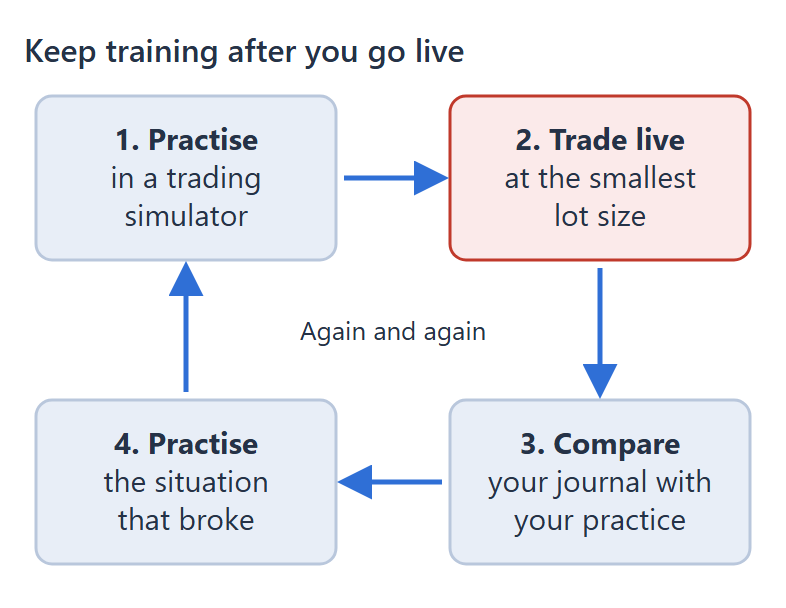
Start live trading with the smallest lot size your broker allows. Your losses stay small, and you still meet the situations that only happen in live trading, such as leaving the screen, being whipsawed and hesitating over a stop loss.
Write every live trade in a trading journal. The guide to keeping a trading journal shows what to write for each trade and how to review it. From your journal, work out your win rate, your average profit and your average loss.
When a trade breaks your plan, add a note about the situation. That note tells you which situation to repeat in your trading simulator next.
What Should You Compare Between Practice and Live Trading?
Compare three numbers: your win rate, your average profit divided by your average loss, and your maximum drawdown. Put the live numbers next to your practice numbers. Keep your lot size where it is until the live numbers come close to your practice numbers.
Measure your maximum drawdown in pips, as in the lesson on maximum drawdown. Pips do not depend on your lot size, so you can compare live trading at the smallest lot with practice at a bigger one.
When one of your live trading numbers is worse than the same number from your practice, it points to the situation that breaks your trading.
| Worse in live trading | What to check |
|---|---|
| Win rate | Trades you would not take in practice, such as trend trades after the price hit your stop loss in both directions, or trades to win back a loss |
| Average profit ÷ average loss | Profits taken early, or stop losses closed late |
| Maximum drawdown in pips | Hesitating to close at your stop loss, or averaging down |
Compare only after you have made enough live trades. After only a few trades, the numbers move a lot by chance.
How to raise your lot size is part of the next lesson, on money management. How to protect your account during a losing streak is also part of that chapter.
Does It Mean Anything if You Keep Breaking Your Rules?
Yes. I started by admitting that I had no special ability, no talent, and that no miracle would happen. But I was frustrated and could not give up, so I put my whole effort into practice and live trading, again and again.
Keeping your discipline is hard, but it is not impossible. When I changed the easy-going way I had lived until then, I became able to keep my discipline.
To other people, that may not look like much. But I believe that admitting your own weakness and working to become stronger always means something.
You have practised this far and you know your own level from your results, so you are already on that path. When live trading breaks your plan, it does not prove that you lack the skill. It shows you the next situation to practise.
Questions About Trading Discipline
- What Is Revenge Trading?
-
Revenge trading is trading outside your plan to win back a loss. It often means a bigger lot size than usual, or adding to a losing trade. In my case, it started with one mistake.
- Should You Keep Practising After You Start Live Trading?
-
Yes. You need your trading simulator to repeat the situations that broke your live trading. Going back and forth between practice and live trading is how you train discipline.
- How Long Does It Take to Build Trading Discipline?
-
It is different for every trader. Instead of counting months, check whether your live win rate, average profit divided by average loss and maximum drawdown have come close to your practice numbers.
- Do Trading Psychology Books Help?
-
Yes. Books on trading psychology show you in advance what happens to traders in live trading. But what matters most is the lessons you learn from your own trades, not the knowledge you read in a book. You learn those lessons by going between practice and live trading, again and again.
Once your rebate account is open, link it to Forex FanClub. The member area lists every rebate payment day by day, across every broker you use. Registration is free and takes an email address.

Produced and operated by Forex FanClub
Person responsible: Hiroki Sakaida, founder of Forex FanClub
Hiroki Sakaida decides what our content and services cover and which features they offer. He also checks content and functionality and decides on revisions and publication. Our Content and Service Policy explains how we produce and check our content and services, including our use of AI.
Risk warning: Forex and CFD trading involve leverage, and you could lose all the money you invest. This article and tool provide information, not investment advice. The amounts shown are calculated from the collected data and do not guarantee the amounts that will apply to your own trades, or any future profit.
Affiliate disclosure: The broker pages linked from this page contain referral links. Forex FanClub receives referral commission based on registrations and trading through those links.
- Why Do Traders Who Win in Practice Lose in Live Trading?
- Is Trading Discipline Just Deciding to Follow Your Rules?
- What Makes Traders Break Their Rules in Live Trading?
- Why Is It So Hard to Follow Your Trading Plan Every Day?
- How Do You Keep Training After You Start Live Trading?
- What Should You Compare Between Practice and Live Trading?
- Does It Mean Anything if You Keep Breaking Your Rules?
- Questions About Trading Discipline